
The Names That Return
In my previous post on “Cousin Rosa,” I introduced her as the daughter of Eliza Huguenin Thomas and John W. Magill. As I have noted in earlier writings, tracing female ancestors often requires the application of different guideposts than those typically employed for men. It is precisely this challenge that made the exploration of Cousin Rosa’s life especially rewarding. Her connection to my grandmother serves as a direct conduit to the maternal line: her mother, her grandmother, and, in turn, my grandmother Ethel and her own mother, also named Ethel. The recurrence of names such as Ethel, Eliza, and Rosa within successive generations complicates the task of remembering and distinguishing individuals. For now, the framework remains largely in my mind, but it becomes increasingly necessary to commit these relationships to writing before the details risk being lost with time.
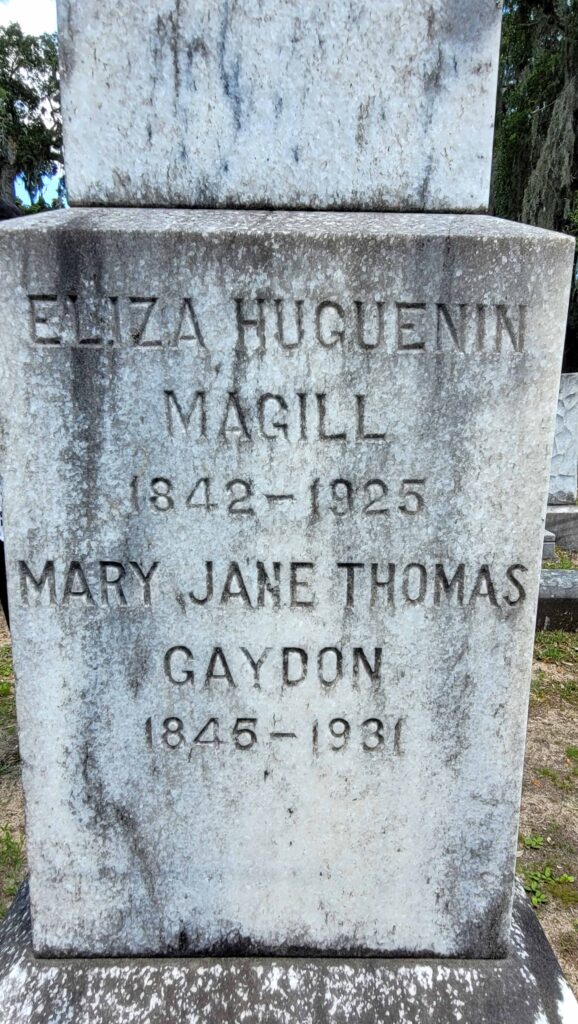
Rosa ultimately became the access point to her mother, Eliza Huguenin Thomas Magill. That realization, however, came only after considerable work had already been undertaken to determine the identities and connections of these women. My initial step in identifying Eliza (not to be confused with her grandmother, also named Eliza Huguenin) included establishing her relationship to her sister, Mary Jane Thomas Gaden. Mary Jane is memorialized with a misspelled surname—rendered “Gaydon”—on her tombstone, while Eliza herself is commemorated as “Eliza Huguenin Magill.” These markers, despite their errors, provide critical anchor points in reconstructing their lineage and situating them within the broader family narrative.
An Education Among Shadows
Eliza Huguenin Thomas Magill, my 2nd great-aunt, was one of seven children in the household of John Joel Abbott Thomas and Malvina Henrietta Huguenin Thomas. She was their first daughter, born into a family that carried both planter-class ties and public service. She may have entered the world in Savannah, Georgia, where her father was employed at the Custom House as an Inspector until 1841. That year, when he was replaced as inspector, the family shifted southward to McIntosh County, settling on “Peru Plantation” beside the estate of his own father, Jonathan Thomas. Jonathan lived at “Marengo Plantation” with his second wife, Mary Ann Williamson Houstoun Thomas. Eliza was only a small child when her grandfather died, a loss that altered the family’s household geography.
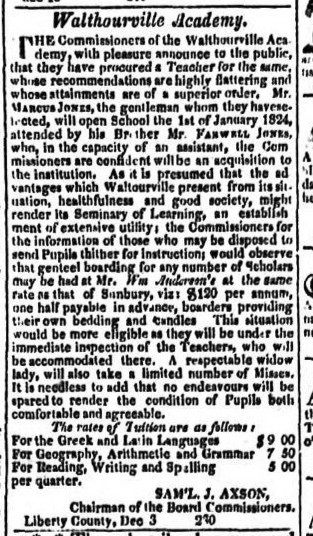
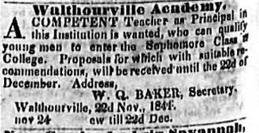
By 1853, Eliza’s parents moved the family again—this time to neighboring Liberty County while still owning the land in McIntosh County. The reason was educational: the Thomases sought the advantages of Walthourville Academy, which had been advertising since the 1840s for teachers to prepare young men to enter college as sophomores. The Academy existed as early as 1823 in the newspapers in Savannah.
The family leased a home “just across from a Mr. Geo. Walthour,” who would, through marriage, become my third great-grandfather. Eliza and her sister Mary Jane struck up a friendship with the Walthour daughters; their bond was deep enough that one of those girls, Alice Walthour, eventually became their sister-in-law, marrying my second great-grandfather Edward J. Thomas in 1862. During this period, Eliza and Mary Jane were taught by a local instructor known as “Miss Calendar.” (quotes are from the diary of my 2nd great grandfather’s earlier memoir in the Georgia Historical Society—transcription still in progress)
The stability of that household ended in 1859 when their father, John Joel Abbott Thomas, died after being thrown from a buggy late that year. His loss coincided with a new chapter in Eliza’s education. According to Edward J. Thomas’s earlier memoir, Eliza was enrolled at “Miss Carey’s School” in Philadelphia. Though I have not yet identified this school, the evidence suggests Eliza was either completing her studies or returning to finish a final course of boarding instruction on the eve of the Civil War. Her sister Mary Jane attended school in Montpelier (I believe this institution was near Macon, GA–she would not likely end up graduating from there).
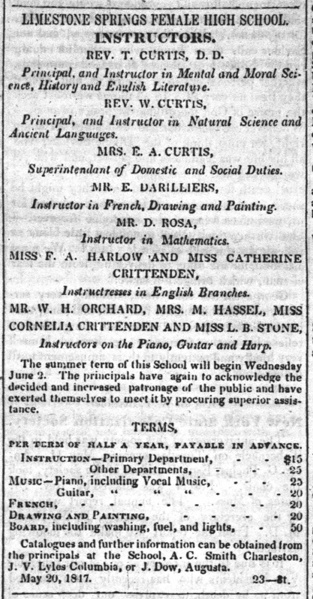
The Walthour sisters pursued their own educational paths: Alice went to Limestone Springs Female High School in South Carolina, where their eldest sister, Eliza Amanda Walthour, married the Reverend William E. Curtis, co-founder of the school with his father, Reverend Thomas Curtis. This web of kinship and schooling illustrates how, by the 1850s, daughters of planter-class families were increasingly expected to receive formal education beyond the rudimentary instruction available by local tutors. For the Thomas girls—Eliza and Mary Jane—attendance at institutions such as Miss Carey’s and Montpelier marked them as pioneers in their family. Their father had himself graduated from the University of Georgia (then Franklin College) in 1835, and both of their older brothers completed degrees at UGA in 1860.
Now the daughters, too, were being folded into the expanding sphere of higher female education.
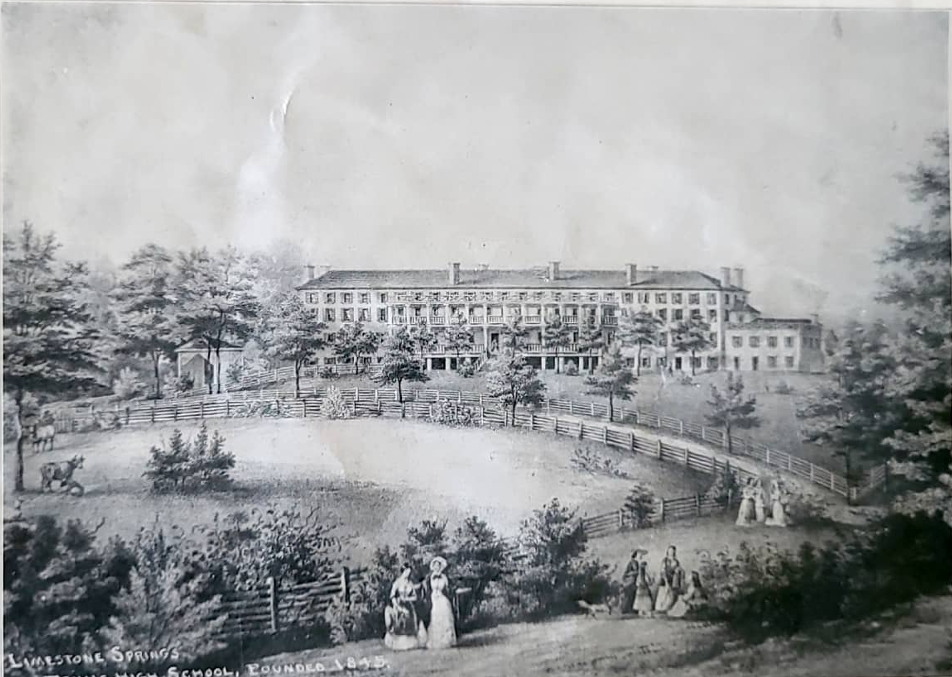
This shift reflected a broader movement in the pre-Civil War South and beyond. Academies, “female colleges,” seminaries, and high schools began to multiply, offering girls access to instruction once reserved for young men. By 1845, Limestone Springs was already advertising a curriculum in “Mental and Moral Sciences, History, English Literature, Natural Science, Ancient Languages, French, Drawing, Painting, and Mathematics.” The Thomas and Walthour sisters were among those who benefited from this transformation.
The location of Eliza’s schooling in Pennsylvania carries particular resonance. To be a young Southern woman in Philadelphia in the late 1850s meant immersion in a city alive with the debates of abolitionism, women’s rights, and suffrage. Newspapers of the period were filled with arguments about the “proper” education for women. Whether or not Eliza herself confronted these ideas directly, her presence in such a milieu made it impossible to remain untouched by the intellectual ferment of the era.
The contradictions of her education would only deepen as the Civil War unfolded. During the war, Eliza, Mary Jane, and Alice (by then a Thomas through marriage) spent time in South Carolina at Limestone Springs to refuge while Edward Jonathan Thomas served in the Confederate States Army. There, these women lived within a space where ideals of intellectual cultivation for women coexisted with the harsh realities of a slaveholding society. The very schools that prepared young women for lives of refinement were sustained by families whose wealth depended on enslaved labor. Eliza’s education, then, was not simply personal advancement; it was also part of a larger social pattern that carried within it the deep fractures of a nation on the brink.
The Lives Between the Lines
Eliza’s story, like Rosa’s, survives through what the record-keepers chose to preserve. Her education, movements, and connections appear in fragments—letters, diaries, newspaper articles, and the occasional line in a census. These traces remind me that what endures of a life often depends on who held the power to record it. The same society that nurtured Eliza’s learning and refinement also rendered others invisible, reducing entire lives to marks on a ledger. As I follow her through these documents, I am reminded that every name preserved on the page exists beside many who were deliberately left unnamed. To understand Eliza’s world—and, by extension, my own family’s—I must look not only at what was written but also at what was withheld. That awareness leads me to the census records themselves: the ledgers that both reveal and conceal the world she inhabited.
The Ledger and the Silences
The 1850 U.S. Census marked a turning point. For the first time, the names of free/white family members in each household were listed, while the enslaved population was relegated to a separate set of “Slave Inhabitants.” These supplemental rolls, kept only for the 1850 and 1860 enumerations, stripped the enslaved of individuality: instead of names, they recorded the name of the enslaver, then only the sex, age, complexion (“B” for Black, “M” for Mulatto), and the number of slave houses. And often, not all the details were filled out (slave dwellings in particular). An additional way to find people is from what was called the Non-Population Schedules, which I would need to see to understand how the family separated out the estate of Jonathan Thomas in McIntosh County soon after his death in 1845.
Reading these records is never easy. The very structure of the census—multiple sets of books, one naming free households and one anonymizing the enslaved—mirrors the historical erasure of those held in bondage. In my own research, I have sometimes encountered only the schedules that listed my family by name, and it is possible, even easy, to overlook the parallel pages that list the enslaved.
But those pages matter as much, if not more. They are part of the story and history.
I remind myself to slow down with Census records, to sit with them, because every detail might count. Are the enslaved listed in sequence by age, as though they were grouped by generation? Or by gender alone? Do the ages suggest family clusters—parents with children? How many people were confined to a single dwelling, and what do the counts of cabins and quarters reveal about daily life? These questions matter.
The stories passed down to me were ones that often carried the message that our family was “good to the slaves.” If that sentimentality may be reflected in the way the censuses were enumerated, I don’t see it. These records provide vital evidence not of the enslavers’ character, but of the individuals they attempted to erase from history.
And for my ancestors, the numbers are staggering. In their own households, they lived alongside and profited from many enslaved people. Through marriages into allied families, those numbers multiplied into the hundreds by the eve of the Civil War. Every story I trace through the Thomas, Walthour, and Huguenin families (just three of the families) exists within the shadow of that bondage. A note to the reader, what follows are primary documents that reflect the way people were enumerated in 1850 and 1860 as they relate to my ancestors directly.
The 1850 Census
In 1850, Eliza was still a child, enumerated with her parents, John Joel Abbott Thomas and Malvina Henrietta Huguenin Thomas, and her siblings in the 22nd District of McIntosh County, Georgia (Harris Neck). Two younger sisters had joined the family: Mary Jane and Malvina Jr. Living next door was her grandfather Jonathan Thomas’s widow, Mary Ann Williamson Houstoun Thomas (listed as Mary A. Thomas), along with her children Mary, James, and Thomas. This detail is more than incidental: the people enslaved on those neighboring properties had once been part of my 4th great grandfather Jonathan Thomas’s holdings before his death in 1845, a stark reminder of how human lives were transferred, divided, and inherited across generations. The wills and papers of Jonathan Thomas’s widow Mary Ann Williamson Houstoun Thomas in the Georgia Historical Society provide access to these transactions before and after his death.
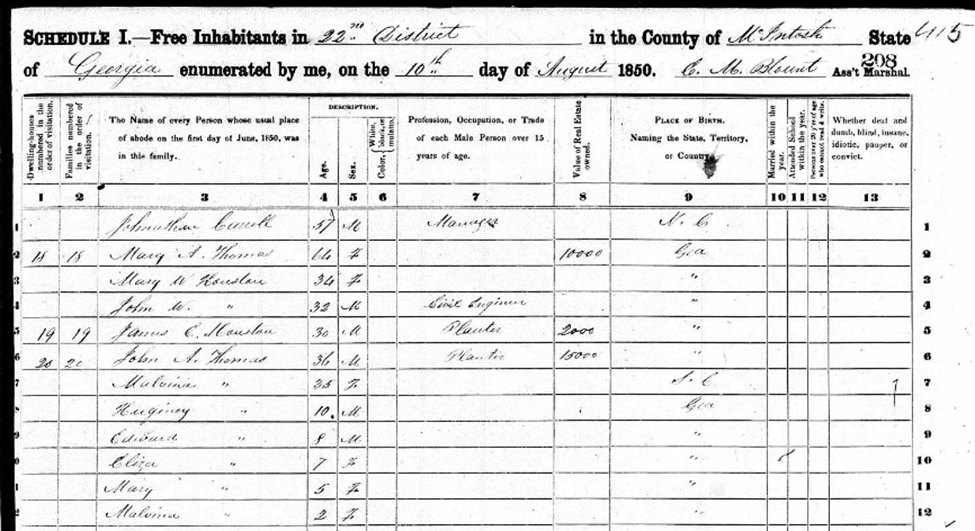
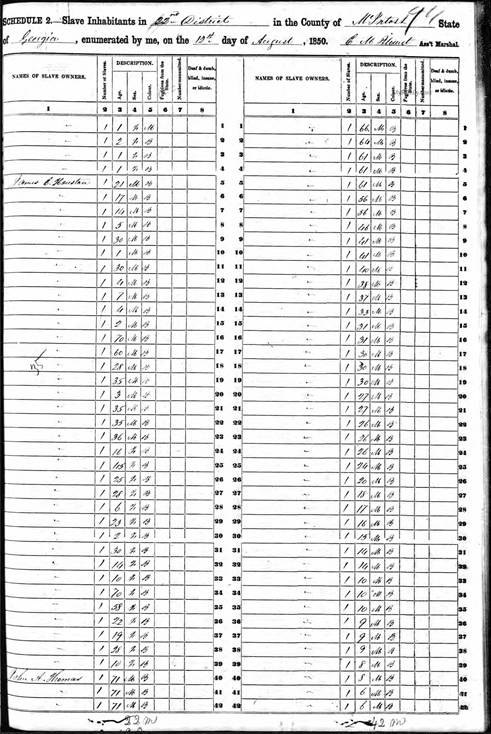
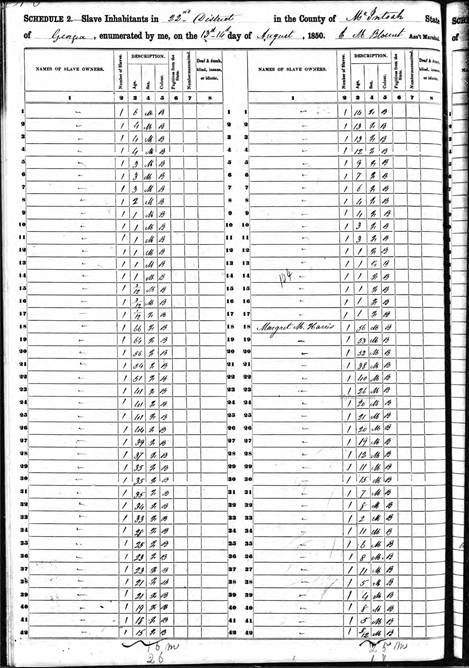
On the corresponding 1850 Slave Schedule for McIntosh County, Eliza’s father, John A. Thomas, appears as an enslaver. His listing—bare ages and not a single name—stands as the clearest record of the people whose forced labor sustained his household. You can see the Enslaved Inhabitants schedule here via Family Search (free to view and save with a Family Search Account). However, I am including the list of the Schedule as it relates to my 3rd great grandfather John A. [Abbott] Thomas. As one can see, the slave houses are not listed, nor are the other areas of the census filled out (two successive pages for his one estate with 118 enslaved enumerated).
The 1860 Census
By 1860, the family had relocated to Liberty County. There are three relevant schedules I have located:
- Liberty County – Free Inhabitants (where the family lived)
- Liberty County – Slave Inhabitants
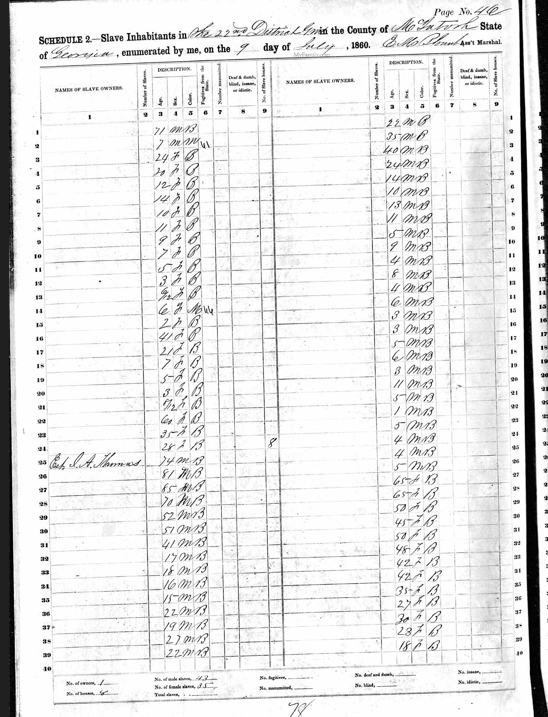
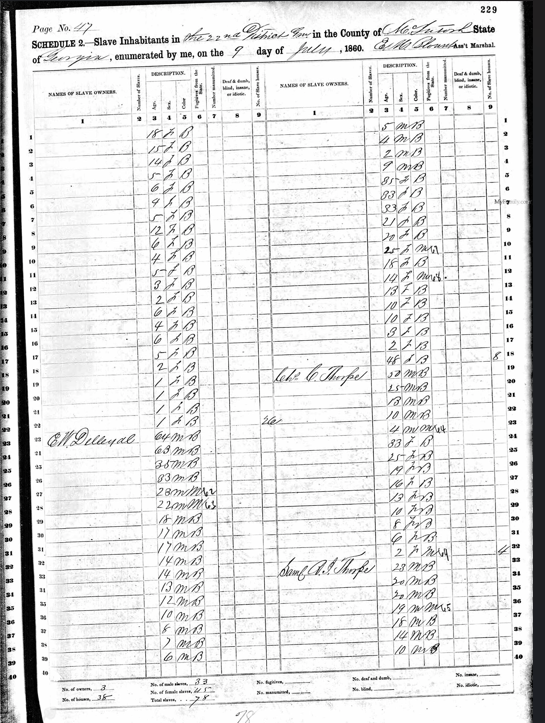
- McIntosh County, District 22 – Slave Inhabitants (estate of J. A. Thomas)
In Liberty County, Eliza appears with her mother and six other siblings. Their father had died in 1859, leaving Malvina a widow with a large household. The four oldest are attending school (marked by the four tick marks to the right of the names).
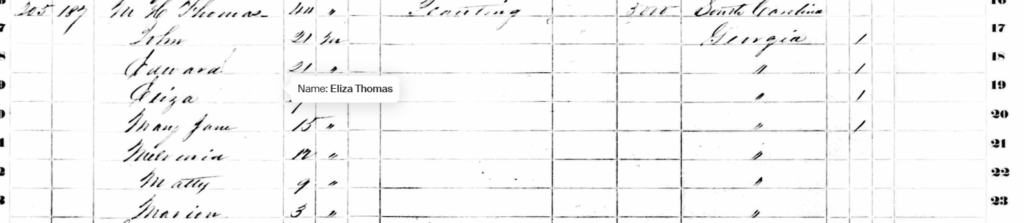
The corresponding 1860 Slave Schedule for Liberty County lists “M. H. Tomas [sic],” very likely Malvina Henrietta/Huguenin Thomas, living near the estate of George Washington Walthour (my 3rd great grandfather, who also died before 1860). This entry records the following enslaved individuals in Liberty:
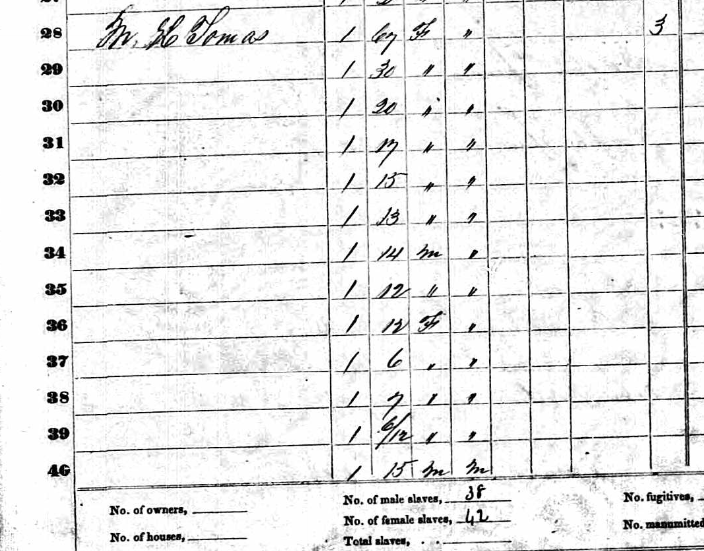
Reconstructed Slave Schedule ( of above)– Liberty County (M. H. Tomas, likely Malvina Huguenin Thomas):
| Sex | Age | Complexion |
|---|---|---|
| Female | 67 | B |
| Female | 30 | B |
| Female | 20 | B |
| Female | 17 | B |
| Female | 15 | B |
| Female | 13 | B |
| Male | 14 | B |
| Male | 12 | B |
| Female | 12 | B |
| Female | 7 | B |
| Female | 6 | B |
| Female | 0.5 | B |
| Male | 15 | M |
Number of slave houses: 3
The above Reconstructed record, in its cold brevity, speaks volumes: a woman of 67, surrounded by younger women and children, alongside two adolescent boys—an intergenerational community held in bondage. The presence of a “Mulatto” raises questions about relationships, lineage, and the lived reality of those enslaved. I will address this more when I turn to the memoirs of my 2nd great grandfather, who in his second paragraph addressed the issue of one “Mulatto” in the list of the supposed 125 enslaved individuals of his grandfather’s estate.
The 1860 Slave Inhabitants schedule for McIntosh County, District 22 (Harris Neck) is reproduced below for the estate of J. A. Thomas (two pages):
When these census records are considered alongside the genealogical details of Eliza’s maternal grandmother and namesake, Eliza Vallard Huguenin, in Chatham County (here: 1 and 2), and the extended Walthour kin in Liberty County (here: 3—note that this record continues for multiple pages), the scope of enslavement grows immense. The records from Chatham, Liberty, and McIntosh counties reveal the full measure of the world Eliza inherited—a world built on the labor and loss of others.
In the years after the Civil War, Eliza married John W. Magill, a union that would reshape the course of her life. The censuses that follow will document the difficult adjustments, the narrowing of means, and the endurance that carried both mother and daughter through what came next—even as Eliza herself begins to fade almost entirely from the public record after 1884. At the same time, the lives of those whom slavery tried to erase begin to emerge more clearly from the same records, offering glimpses of continuity, resilience, and humanity that had long been obscured.