The Torture and Murder of Cato
Colonel’s Island, Liberty County, 1846
There are some days in my research when I dedicate an entire afternoon to a single FamilySearch collection for one county, hoping that by moving page by page, front to back, something overlooked will finally emerge. Names like “Baker” or “Thomas” can become almost impossible to untangle in coastal Georgia research. The surnames repeat endlessly, and even promising documents often reveal nothing certain at all.
For some time now, I have been trying to determine who exactly my Baker ancestors were in McIntosh County. So far, I have established that my fourth great-grandfather Jonathan Thomas married Mary Jane Baker, daughter of Bright Baker and Jane Harris Baker. But the identity of Bright Baker’s own parents remains unresolved. Liberty County has long seemed like the most likely place to continue searching. Before McIntosh County was formed, the area had been part of Liberty County, and the Baker families there appear repeatedly throughout the records. Were these other Bakers — many of them in Sunbury and on Colonel’s Island — Bright’s relations? I still don’t know.
When I say I am flipping through every page, I do mean every page. Developing a system for recording what I find has become one of the most difficult parts of genealogy research. My current method is simple but effective enough: I keep handwritten notes with the film number, image number, date, and brief descriptions of what appears on each page. Years ago, I tried saving every document into a FamilySearch source box, but that approach quickly became unmanageable when documenting entire collections at once, especially when much of the material might not relate directly to my own family.
The consequence of this type of research is that I inevitably learn far more about Liberty County than I ever knew. In many ways, that broader understanding becomes useful. It helps situate my ancestors within a larger community and reveals the network of neighbors, associates, witnesses, attorneys, and enslavers surrounding them. But it also means encountering documents that stop me completely. The history of slavery should not make records like these surprising, yet I did not expect to find a murder trial sitting in a loose file collection among probate and divorce papers.
On image 385 of one Liberty County collection*, after several lawsuits involving Simeon S. Moody and James F. Baker from 1840, the next page abruptly shifted into something else entirely: the details surrounding the brutal death of an enslaved man named Cato on Colonel’s Island in Liberty County by James F. Baker for which Baker was being charged with murder. My heart sank as I read the pages.
The files that followed stretched for roughly 20 pages.
Before I did anything further with the documents, I turned to one of the best online resources for Liberty County research: They Had Names: African Americans in Early Records of Liberty and Bryan Counties, Georgia. Searching for James F. Baker there, I found a “collateral” document involving two enslaved people, John and Cloe, used to secure a bond requiring Baker’s appearance in court. In the transcription accompanying the document was a brief note: “[NOTE: the reason why James F. Baker was to appear before the court was not specified.]” I have relied on Stacy Ashmore Cole’s work on this website for years when trying to piece together corroborating records and to reconstruct the lives that appear only fragmentarily in county documents. I reached out to Stacy — both a mentor and a friend — to ask whether she had ever encountered the material I had uncovered while searching for my own Baker family connections. She had not, but she immediately began helping me trace additional references to James F. Baker. Together, we started assembling the scattered evidence surrounding Cato’s death and the rare prosecution of an enslaver in Liberty County, even if the legal consequences still reflected the protections afforded to a man of property and standing.
What began as a general probate search slowly unfolded into an inquest, habeas corpus petitions, bond proceedings, criminal conviction, penitentiary records, property transactions, and eventually the will of James F. Baker himself. What survives is not simply the story of a violent death, but a rare documentary trail showing how the legal system responded when an enslaver was prosecuted for killing an enslaved man — and how little in Baker’s broader financial and social world appears to have ultimately changed because of it.
Most importantly, the records hint at the possibility that Cato himself may yet be traceable within the broader network of enslaved families on Colonel’s Island or in Liberty County.
The murder of Cato is horrendous, brutal, and deeply disturbing, so please know that what follows contains descriptions of violence that will be difficult to read. The American slave system was built not only upon forced labor, but upon the legal and social power to control, punish, terrorize, and dehumanize other human beings. Documents like these force that reality to the surface in ways that are impossible to soften. I have chosen to write about Cato not to sensationalize his suffering, but to memorialize him as a person whose life and death were recorded only briefly in the official archive. His murder, and the records that survive it, remind us that the violence of slavery was not abstract, accidental, or peripheral to the system — it was the basis of its foundation.
The first document is an inquest taken on 6 May 1846 before Robert Q. Andrews, Justice of the Peace of Liberty County, GA, acting in the absence of the county coroner.
— ✦ —
The Inquisition: May 6, 1846
The document is a formal legal record — an inquisition conducted on May 6, 1846, at the plantation of James F. Baker on Colonel’s Island, Liberty County, Georgia. The county coroner being absent, Robert Q. Andrews, Justice of the Peace, presided. Twelve men were sworn as jurors. What they found, and formally attested to under oath, is worth reading in their own words.
TRANSCRIPTION*
An inquisition indented, taken at the plantation of James F. Baker on the Colonel’s Island in the said County of Liberty the sixth day of May, in the year of our Lord Eighteen Hundred and forty six, before Robert Q. Andrews Justice of the Peace for & in the County of Liberty, the Coroner for said County being absent, upon the view of the body of a negro man slave, the property of the said James F Baker, called by, and bearing the name of Cato, then and there lying dead, upon the oaths of Wm. Maxwell, foreman, Henry Jones, Cyrus Mallard, Edward J. Delegal, Henry H. Delegal M.D., Wm. Thompson, Thomas Dunham, John Stevens, Joseph Stevens, Wickham Gould, John W. A. Fennel and William E. Screven good and lawful men of the County aforesaid;
who, being sworn, and charged to inquire on the part of the State aforesaid, when, where, how, and after what manner the said negro man slave, Cato, came to his death, so say upon their oath that the said James F. Baker of said County and State, not having the fear of God before his eyes, but being moved seduced by the instigation of the Devil, on the Eighteenth day of April in the year of our Lord Eighteen Hundred and forty six aforesaid, with force and arms at the Colonel’s Island aforesaid, on the plantation of James F. Baker aforesaid, in the County of Liberty, and State aforesaid on and upon the aforesaid negro man slave, Cato, then and there being in the peace of God and the said state, feloniously, voluntarily, and of his malice aforethought, made an assault, and that the said James F. Baker then and there closely confined, whipt and brutally beat the said negro man slave Cato, and then & there inflicted severe wounds upon the buttocks and stern of the aforesaid Cato: so that the worms and maggots were seen in the said wounds;
and the aforesaid James F. Baker, then and there around the neck of the aforesaid negro man slave Cato did place and fasten a certain heavy piece of iron, of the weight of Twelve pounds and a quarter, and of the value of twenty five cents, and then and there did fasten to the aforesaid piece of iron a certain iron chain, and attached the said chain to the joist above the head of the aforesaid Cato, so that he could not lie down or recline, and did then & there fasten the feet of the said negro man Cato in stocks, bruising & injuring the feet and ankles of the aforesaid Cato of which violent treatment, and wounds of the aforesaid aforesaid piece of iron on & about the neck of the aforesaid Cato, the said Cato died.
And the aforesaid Jurors further say upon their oaths that the aforesaid James F. Baker did take the body of the negro man slave Cato into the woods and there dug a hole in the ground, and threw in the body of the said Cato, with the said piece of iron still fastened to the neck without coffin or winding sheet, and clandestinely covered it up there in. And so the said James F. Baker then and there feloniously killed and murdered the said negro man slave Cato against the peace and dignity of the State.
In witness whereof as well as the aforesaid Magistrate acting as coroner, as the Jurors aforesaid have to this inquisition put their seals on the day and year aforesaid, and at the plantation of Mr. John Stevens near the Colonel’s Island in said County and State.
Wm. Maxwell, foreman [seal] Henry Jones [seal] Cyrus Mallard [seal] Edward J. Delegal [seal] Wm. G. Thompson [seal] Thos Dunham [seal] John Stevens [seal] Jos. L. Stevens [seal] Wickham Gould [seal] G. W. A. Fennel [seal] W. E. Screven [seal] R. Q. Andrews J. P.
What the jurors described was a prolonged torture. Cato had been beaten so severely that his wounds had become infected — “worms and maggots were seen in the said wounds.” He had been chained upright by the neck with an iron weight so heavy he could not lie down. His feet were locked in stocks. He died from this treatment. And afterward, James F. Baker carried the body into the woods, dug a hole, and buried Cato there — iron still around his neck, no coffin, no winding sheet — and covered it over in secret.
The inquisition concluded that Baker had “feloniously killed and murdered” Cato. The murder itself had occurred on April 18, 1846 — more than two weeks before the body was formally examined. We know nothing more about Cato himself: not his age, not his history, not where he came from or how long he had been enslaved by Baker. Beyond these records, almost nothing of Cato himself survives in the archive.
— ✦ —
The Legal Proceedings: 1846–1847
James F. Baker was taken into custody. On May 11, 1846 — just five days after the inquisition — Baker petitioned the Liberty Superior Court for a writ of habeas corpus, and again the following week in the Inferior Court. The first court was divided and remanded him to jail. The second court, by majority, admitted him to bail at six thousand dollars, with Richard F. Baker and Robert C. Hines standing as his securities.
Meanwhile, on May 12, Thomas J. Dunham and R. W. Gould each paid a $300 bond guaranteeing that Dunham would appear before the Superior Court concerning the death of Cato. Baker was released and waited out the summer. On November 13 his case was scheduled to be heard in Hinesville.
In December 1846, Baker executed an indenture with Richard F. Baker and a Michael Dorsey [Dancy/Darcey?] of Chatham County, offering his Colonel’s Island property as security for their bond — along with two enslaved people, John and his wife Cloe. The land sat adjacent to that of Roswell King and A. C. Hart. John and Cloe would be sold the following year through Baker’s agent, George W. Walthour, to Simeon S. Moody for $401*.
The surviving records do not always make the exact legal arrangement immediately clear. In these archives, land, debt, securities, bonds, and enslaved people move together through the same transactional language. What is clear is that even while facing criminal prosecution, Baker’s financial affairs remained active and protected through associates and intermediaries.
The trial came in April 1847. The jury had found Baker guilty — but not of murder. The charge was reduced to involuntary manslaughter in the commission of an unlawful act. Before the sentencing the jury also pled for “mercy of the court” to James F. Baker. The sentence ordered that Baker: “be confined at hard labor in the penitentiary at Milledgeville… for the space of two years.”
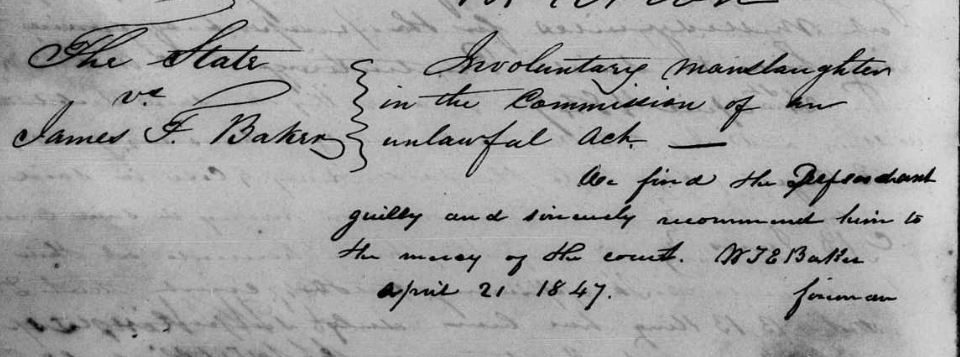
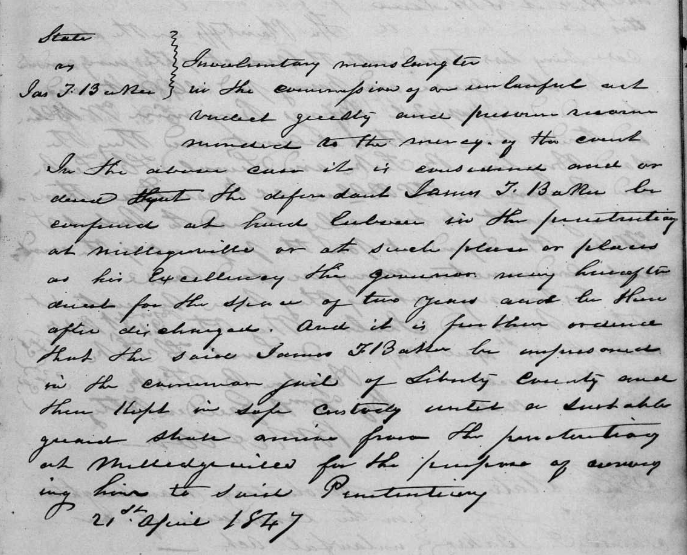
TRANSCRIPTION OF VERDICT
State vs Jas. F. Baker
Involuntary Manslaughter in the commission of an unlawful act. Verdict guilty and [prisoner] recommended to the mercy of the court. In the above case it is considered and [decided] that the defendant James F. Baker be [confined] at hard labor in the penitentiary at Milledgeville or at such place or places as his Excellency the governor may hereafter direct for the space of two years and be hereafter discharged. And it is from there ordered that the said James F. Baker be imprisoned in the common jail of Liberty County and then kept in safe custody until a just able guard shall arrive from the penitentiary at Milledgeville for the purpose of conveying him to said Penitentiary.
21st April 1847
— ✦ —
The Convict Register at Milledgeville
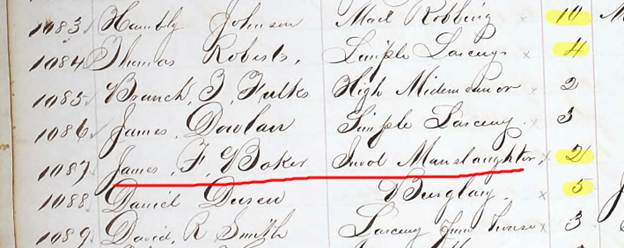
Baker’s entry in the Georgia Central Register of Convicts confirms his sentence. What makes it particularly striking is the context of the surrounding entries — men serving equal or longer sentences for simple larceny, mail theft, or burglary. Baker, convicted in connection with the prolonged torture and killing of another human being, received less time than some who had stolen property. Once I stitched together the register entries, it appears that Baker did not serve long in the penitentiary: he was pardoned on 28 August 1848 after serving only fifteen months of his sentence.


— ✦ —
After Prison: The Will of James F. Baker
On 1 June 1847, George W. Walthour — my third great-grandfather — acting as agent for James F. Baker, sold the enslaved people John and Chloe at public outcry. Simeon S. Moody purchased them for $401. These are most likely the same two enslaved people mentioned above in 1846 used as collateral.
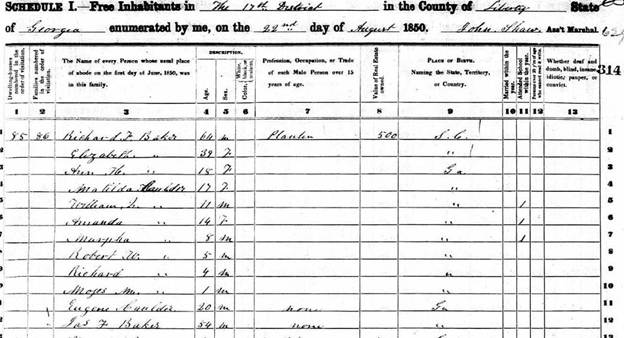
By 1848, Baker had been released and appears in the federal census in 1850 living in the 17th District of Liberty County with family member Richard F. Baker.
On May 12, 1849 — while he was still managing his affairs, Baker wrote his will. It is a document remarkable for both bitterness and self-pity, and in it appears something deeply familiar to me by now: my own family embedded within the machinery of slavery. I have come to understand that my family in almost every branch from South Carolina to Georgia were the faces of the American slavery system.
TRANSCRIPTION
In the name of God Amen!
I James F. Baker of aforesaid State and County, knowing the mortality of man and ignorant as to what a day or an hour may bring forth, so in my right mind and disposing memory, make and ordain this my last will and testament, hereby revoking any other will that I may have heretofore made.
First, I commit my body to the earth from whence it was taken, and my soul I commend unto the God who gave it trusting to his mercies for a home in heaven.
Second, I give and bequeath to my wife Sarah J. Baker, five dollars. I would give her an equal share with my son, but to her unforgiving temper, may be attributed some of the misfortunes which have overwhelmed me since our separation.
Third, my daughter, having left this vale of tears, for a brighter world, I give and bequeath the whole of my estate both real and personal that I may die possessed of, to my son James A. Baker; But should my said son die without wife or children, then the property shall be vested in the children of my Brother Thomas, except the legacy of five dollars as mentioned above.
Fourth, I request my son to present to my much esteemed friend G. W. Walthour a gold headed cane as a slight testimonial of my regard for him. And lastly, I constitute my friend G. W. Walthour and my son James the executors to this my last will and testament.
In witness whereof I have hereunto set my hand and seal this twelfth day of May, one thousand eight hundred & forty nine.
Signed, sealed & acknowledged in presence of: S. S. Moody Jas. F. Baker [seal] J. S. Bradwell C. Hines JJC
It’s striking that Sarah J (married named Sarah J. Hatch). Baker, James’s wife, was left with a mere five dollars at the end of this man’s life. Is he blaiming her for his misfortunes? It appears so.
And in the fourth paragraph, G. W. Walthour, my 3rd great-grandfather, is named as Baker’s “much esteemed friend,” to receive a gold-headed cane as a token of his regard. He and Baker’s son James are appointed co-executors of the estate. Walthour had already been acting as Baker’s agent while Baker was imprisoned, selling the enslaved people John and Cloe and handling other financial affairs on his behalf.
I was not looking for Walthours when I started this search. I was looking for Bright Baker. And yet here George Washington Walthour appears, intertwined with the man who murdered Cato — his close friend, his principal, his business associate. The will was proved on April 4, 1853, and the estate appraised shortly thereafter.
— ✦ —
A Final Document, 1854
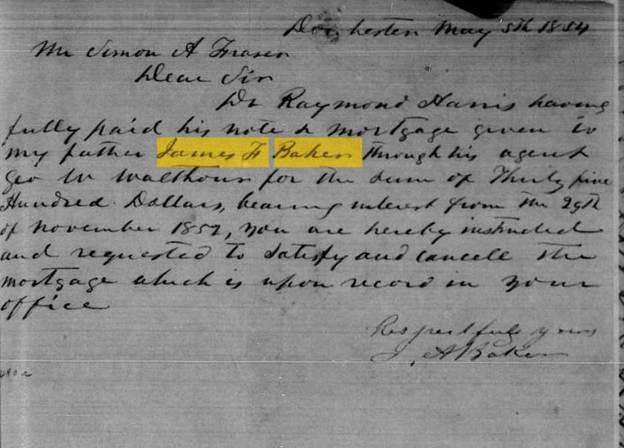
One more record closes out the paper trail I have found so far. A May 5, 1854 document concerns a promissory note from October 1852, in which Baker — again through his agent Walthour — had mortgaged 450 acres on Colonel’s Island and eight more enslaved people: Grace, Will, Ned, Watty, Sam, Binah, Rachel, and Jack. Raymond Harris had given the note for $3,500. By 1854, Harris had fully paid it, and the mortgage was satisfied and cancelled by Baker’s son, J. A. Baker.
— ✦ —
What the Records Leave Behind
I came to Liberty County records looking for Bright Baker. I didn’t find him — not yet. What I found instead was Cato: a man whose name appears only because he was killed, whose life the records do not preserve, whose burial place in the woods of Colonel’s Island was unmarked and clandestine. The formal language of the inquisition, “feloniously, voluntarily, and of his malice aforethought,” names what happened plainly, even as the legal system then quietly reduced it to a mere 15 months.
And I found my own family in the middle of it. George W. Walthour was Baker’s trusted agent, the man he called his “much esteemed friend,” the one he asked to receive a gold-headed cane. Walthour was not simply another participant in the world of coastal Georgia slavery; by the mid-nineteenth century, he was among the largest landowners and enslavers in Liberty County. That he was deeply enmeshed in the economic and social world that sustained men like Baker was not a surprise — that is the world his records inhabit. But finding him, unexpectedly threaded through the documents surrounding Cato’s murder, is the kind of thing that stops me every time.
Cato entered the archive through violence. Nearly two centuries later, the records still preserve enough to say his name and to reconstruct the circumstances of his death. Yet perhaps this is not the end of the story. Resources like They Had Names: African Americans in Early Records of Liberty and Bryan Counties, Georgia make it possible to follow fragments scattered across estate files, inventories, mortgages, and court records that may yet reveal more about Cato’s life, his family, and the community around him on Colonel’s Island. The evidence remains incomplete, and the work is slow, but his name no longer survives only within the record of his murder. I am deeply grateful to Stacy Ashmore Cole for her extraordinary work preserving and connecting these records, and for the generosity and encouragement she offered while helping me piece together the scattered documents that made this article possible.
*Additional Documentation for this blog post:
Original Inquisition of James F. Baker for the murder of Cato: FamilySearch, Liberty County Probate Records, Images 385-387, https://www.familysearch.org/ark:/61903/3:1:3QS7-L9Q4-ZJNX [NOTE: many more documents occur after this one in succession, and to view the entire loose files, click forward to view the content of the case]. In the documents that follow, more evidence of the state of Cato’s body are included, which are very disturbing to read.
Petitions by James F. Baker in 1846 to be released on bond: https://www.familysearch.org/ark:/61903/3:1:3Q9M-C3H3-49HH-4
Thomas J. Dunham and R. W. Gould must appear before the court regarding the death of Cato: https://www.familysearch.org/ark:/61903/3:1:3Q9M-C3H3-49HH-4
Bonds by Richard F. Baker and Robert C. Hines guaranteeing James F. Baker will attend court in November Term (this case would not be settled until the April Term of the court, so this is his first appearance requirement): https://www.familysearch.org/ark:/61903/3:1:3Q9M-C3QP-5C1B
Verdict of James F. Baker, April 21 1847. Source: FamilySearch, Liberty County Court Records https://www.familysearch.org/ark:/61903/3:1:3Q9M-CSLZ-F5PW
Used as Collateral (Baker/Baker-Dorsey), Enslaved persons John and his wife Cloe (1846): https://theyhadnames.net/2019/12/05/used-as-collateral-baker-baker-dorsey/
1 June 1847, George W. Walthour, agent for James F. Baker, offers to public outcry slaves John and Chloe, which were purchased by Simeon S. Moody for $401 https://www.familysearch.org/ark:/61903/3:1:3Q9M-C3QP-5HG3
1849 Will of James F. Baker: https://www.familysearch.org/ark:/61903/3:1:3QS7-L93T-XB8R