Fragments of a Family Story
About a year ago, I began creating folders for individual family members, gathering whatever evidence surfaced as my research intensified. What started in 2023 as a vague, single folder—with a Word document summarizing what I thought was my family tree—quickly unraveled. That document went through multiple rewrites, additions, and hard deletions as I realized how much I had misunderstood the scribbled notes from conversations with my grandmother in my late twenties and thirties. Memory is tricky. Research is too, though I’m getting better at both.
Those folders have multiplied. The story of my second great-aunt Eliza Huguenin Thomas and her married life as a Magill has taken me on a rollercoaster ride, fueled by fragments gathered from people intrigued by my family history, from scholarly articles on the Freedmen’s Bureau, from courthouse records in McIntosh County, Georgia, and from obituary notices scattered across the country—including one describing the suicide of a Magill in the Atlanta area.
Atlanta. My hometown.
Not the coast, as I had expected. Not Savannah, where I assumed these Magills would remain close to the Thomas family. Instead, I would discover that the Magill who married into my family was connected to the Magills, Smiths, and Merrells of Roswell, the very place where I now live. That folder continues to grow—wider, stranger, and more unruly with every passing day.
The folder for Eliza is labeled “ETHM and JW Magill.” Over a year ago, I wrote the following on its cover to mark where I stood at the time:
Eliza Hugenin Thomas Magill marries John W(illiam?) Magill in 1868.
Brick Walls: Is he a widower?
Only Child: Rosa Elizabeth Magill—attends high school in Iowa.
ETHM appears to be a widow by 1884—tries boarding house venture in NYC.
1881: John William Magill in Atlanta dies by suicide-is this our Magill?
1880 Census Atlanta (Sugar Hill, Gwinnett): J. W. + Eliza + Rosa.
Theory: J. W. lost money; Eliza retained properties at Peru/Stark/Low in McIntosh County (acquired mid-1870s).
Rosa sent to Iowa for boarding school or lived with family there.
Eliza’s census record lost for years.
Dies in NYC, 1925 (?); likely lived final years with Rosa.
Looking back, that note captures both what I knew—and how much I didn’t.
Chasing Shapeshifters—John Magill
What follows is what I’ve been able to reconstruct so far. John W. Magill was born around 1820 in Placentia, Newfoundland, to William Magill and a mother whose identity is still emerging. He was one of three children: his older brother Charles James Magill (b. 1818), who left home young to become a sea captain, and his younger sister Sarah Eliza Magill (b. 1823), who remained in Newfoundland and married Henry Corbin Le Messurier.
William Magill, John’s father, was the son of Charles Magill and Sarah Denny, born in Middletown, Middlesex County, Connecticut.
Some Denny family genealogies identify the children’s mother as Rosella Morner, but the evidence points elsewhere. I now suspect she was Rose (or Rosa) Morriss/Morress Magill (d. 1858 in Newfoundland), possibly the daughter of Lieutenant John Morriss/Morress. I located her obituary, which indicated she was the oldest daughter of Lieutenant John Morriss/Morress, along with wills belonging to her sister and mother—both named Mary—each offering faint but suggestive glimpses into their lives.
This line of inquiry is still unfolding. It has also reminded me how authoritative-looking genealogies can mislead researchers, particularly when their claims harden into “fact” without documentary support. Though my focus is Eliza, her husband’s origins keep pulling me into deeper and more complex terrain.
Why Newfoundland?
The Magills’ presence in Newfoundland appears shaped by family networks. William Magill’s sister, Eliza Magill, married Edward Dunscombe of Bermuda, and the couple lived in Newfoundland for many years. John’s brother, Charles James, also married a Bermudian woman, Esther Ann Stowe Chalker.
The Magill network stretched across Bermuda, Newfoundland, Connecticut, Chicago, the southern United States, and Europe. Tracing John W. Magill’s origins has taken me across these geographies, only to discover that some of his cousins eventually settled in Roswell, Georgia, through Smith/Magill/Merrell marriages.
Becoming “American”
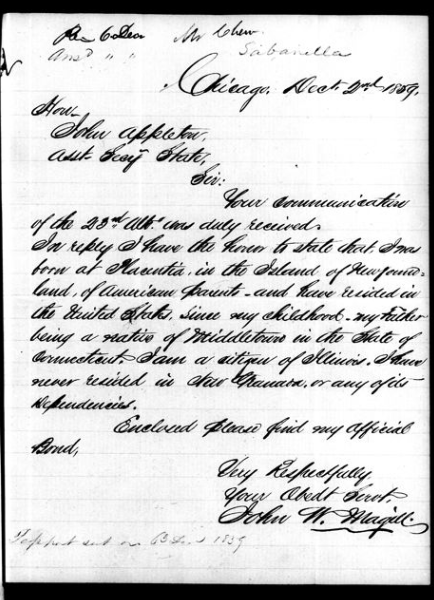
John W. Magill’s birthplace is confirmed by a letter he wrote in 1859 to John Appleton, U.S. Assistant Secretary of State, while seeking appointment as U.S. Consul to Sabanilla, New Granada (now Colombia). Finding this document was momentous. At first, it simply confirmed that I wasn’t imagining his Newfoundland origins. I remember shouting to my husband from my office, “I found him! He WAS born in Newfoundland!”
That letter, however, was only the beginning.
In it, Magill claimed he had lived in the United States since youth and identified himself as a “citizen of Illinois.” He also asserted that both of his parents were American-born—a statement that appears only half true. His father was from Connecticut; his mother almost certainly was not.
My own discovery of John W. Magill began, fittingly, not in an archive but in a family Bible. On one of its “Family Record” pages appears a simple entry:
Eliza H. Magill, born 1842, died December 1925, New York.
The page itself tells a story. The handwriting shifts—different pens, different hands, different moments in time. I recognize the script of my second great-grandfather, and nearby, that of my great-grandfather. Each added what he knew, or what he thought he knew, leaving behind fragments rather than a narrative. That Bible did not explain who Eliza married, where she lived, or why she died in New York. It only confirmed that she existed—and that others had tried to remember her.
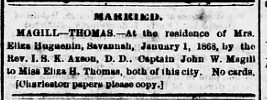
At some point—though I can no longer pinpoint when—I must have searched for her marriage. When I found a newspaper notice identifying her husband as John W. Magill, the search widened.
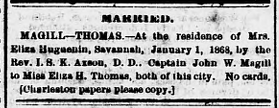
Suddenly, Eliza was no longer anchored only to the Thomas family of coastal Georgia. She was tethered to someone whose paper trail was scattered, contradictory, and expansive.
About two years ago, I encountered an online article by historian Allison Dorsey, “The Great Cry of Our People Is Land!: Black Settlement and Community Development on Ossabaw Island, Georgia, 1865–1900.” The article details the extraordinary post–Civil War history of Ossabaw Island, including the leadership of Tunis Campbell, the story of Mustapha Shaw, and the fragile promise of land under Special Field Order No. 15.
The opening lines stopped me cold. There, named plainly, was “J. W. Magill, an agent of the Freedmen’s Bureau on Ossabaw Island, with the firm of Flye, Magill & Middleton.”
Without Dorsey’s scholarship, I would not have found the first solid historical footing for Eliza’s husband. More importantly, her work placed Magill inside a profoundly consequential moment—one shaped by newly emancipated people asserting land, autonomy, and community against overwhelming resistance. I would not dare attempt to expand on her scholarship here; her work stands on its own. (An interview with Dorsey discussing Mustapha Shaw can be found through Swarthmore College.)
That discovery sent me deep into Freedmen’s Bureau records, where Magill’s name surfaced intermittently amid labor contracts, reports, and correspondence documenting the uneasy transition from slavery to freedom. As I searched for him, I became immersed in the lives of people newly emancipated—choosing or changing surnames, negotiating labor, asserting family ties, and navigating a bureaucracy that was often hostile, inconsistent, or actively undermined by men like Magill himself.
I don’t remember exactly how I first found those records. That, too, has become part of the pattern. Proof often arrives without ceremony, and just as often slips out of reach. Some days the trail is clear; other days it dissolves entirely.
During this research, I also learned that John and Eliza Magill ran the Magnolia Hotel in Darien, Georgia, during the 1870s.
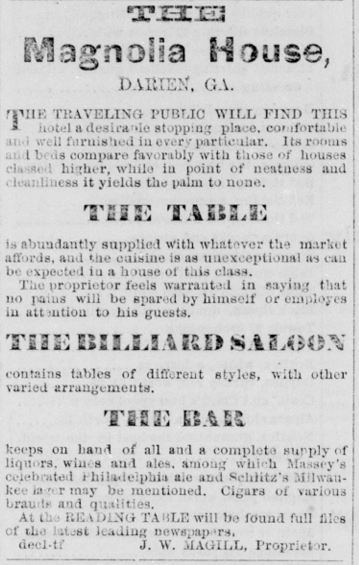
A local historian in Harris Neck later told me that John and Eliza attempted to sell all of Eliza’s inherited family land but were stopped by other members of the Thomas family. He showed me an indenture in which John, for five dollars “in hand,” transferred the entire contents of the Magnolia Hotel to his wife.
It was a striking document—perhaps an act of desperation, perhaps a moment of calculation, perhaps both. In time, Eliza would need whatever assets she could retain to survive her husband’s relentless ability to burn through other people’s money.
The Hunt Through Archives
Dorsey’s article set off a chain reaction. As I combed through Freedmen’s Bureau files, I began encountering adjacent records that reshaped my understanding of the Civil War economy itself. I stumbled across Slave Payroll vouchers from Confederate facilities and laboratories in Macon and Savannah, documenting the forced labor of enslaved people during the war.
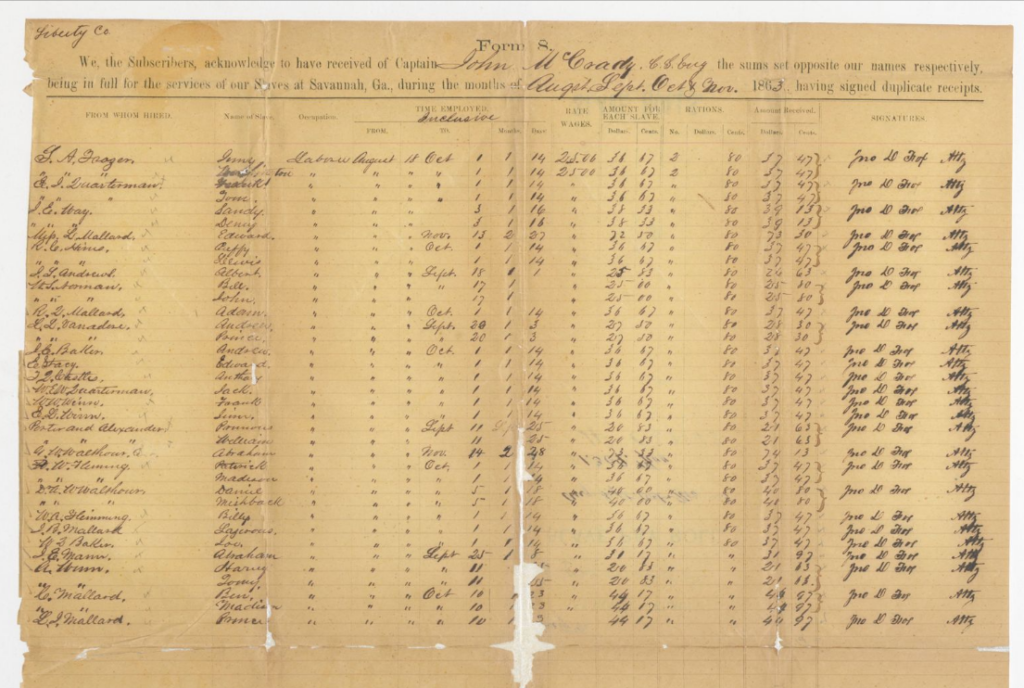
These records list enslavers, first names—and sometimes surnames—of the enslaved, rates of pay, hours worked, and the authorized agents who collected wages while heads of households served in the Confederate army. They reveal a system that did not “pause” slavery during wartime, but instead intensified exploitation in the name of production.
I have since identified several Walthour, Thomas, and Huguenin ancestors who profited from this system. These discoveries are uncomfortable, but necessary. They also form the backdrop against which men like John W. Magill operated—adept at navigating systems of power. To find more information about this valuable resource, here is a link to the Payrolls: https://www.archives.gov/files/citizen-archivist/images/09-16-2021-confederate-slave-payrolls.pdf
Magill as U.S. Consul
The first hint that John W. Magill had served as a U.S. Consul came not from government records, but from an 1881 obituary in the Atlanta newspapers. That notice was my earliest indication that Magill lived multiple lives—if, in fact, this was the same man.
The obituary claimed he had served as a minister to Brazil during the Buchanan administration, that he was down on his luck at the time of his death, and that he remained well connected to Savannah society. Those claims proved exaggerated, but not wholly fabricated.
By the mid-1850s, there is ample evidence that Magill served as a U.S. Commissioner of Deeds, operating across multiple states while living in Chicago where his brother lived in the shipping industry. John Magill handled estates, conveyances, and affidavits—positions that required trust, political alignment, and the ability to move easily between jurisdictions. He was also a supporter of James Buchanan, whose administration was sympathetic to Southern interests.
In 1859, Magill had sponsors write to President Buchanan recommending him for diplomatic service. His earliest request was for a post in Africa; eventually, it shifted to Sabanilla, a port in New Granada (now present day Columbia). The correspondence surrounding this appointment survives in the National Archives, scattered across consular dispatches and State Department records.
After receiving his commission, Magill sailed from New York to Sabanilla, a journey that took many weeks. Almost immediately, his dispatches turned sour. He complained about his salary, about being stationed in Sabanilla rather than the more desirable Barranquilla, and about the ships entering port without proper paperwork or respect for his authority. His reports carry the unmistakable tone of a man convinced the position was beneath him.
Near the end of his tenure, Magill was accused of accepting bribes from foreign vessels, allowing them to pass under the American flag. In 1861, he abruptly resigned, left Sabanilla, returned to the United States—and aligned himself with the Confederacy. One of the final letters in his consular file is a missive to a fellow Consul, laced with racist slurs directed at Abraham Lincoln and his cabinet.
From US Consul to Confederate soldier
By 1863, Magill was again leveraging family and political connections—this time through Mrs. Henry Merrell, his first cousin Elizabeth Pye Magill—to solicit a letter from General Royston to Jefferson Davis, seeking a new position that conveniently emphasized his prior diplomatic service.
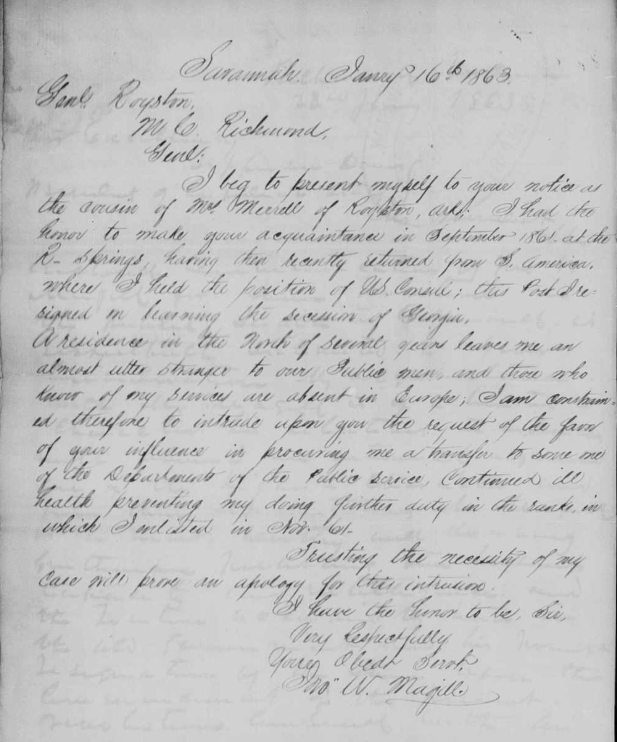
All of this points to a man adept at reinvention. Money, position, and movement mattered most. Magill was successful at selling his usefulness—often amplifying the importance of his role while minimizing the labor itself. He secured a post with Daniell’s Light Artillery, managing provisions for troops in Savannah, and receiving regular compensation for his services. The pattern is unmistakable: wherever power could be brokered through paper, proximity, or persuasion, John W. Magill found his way in.
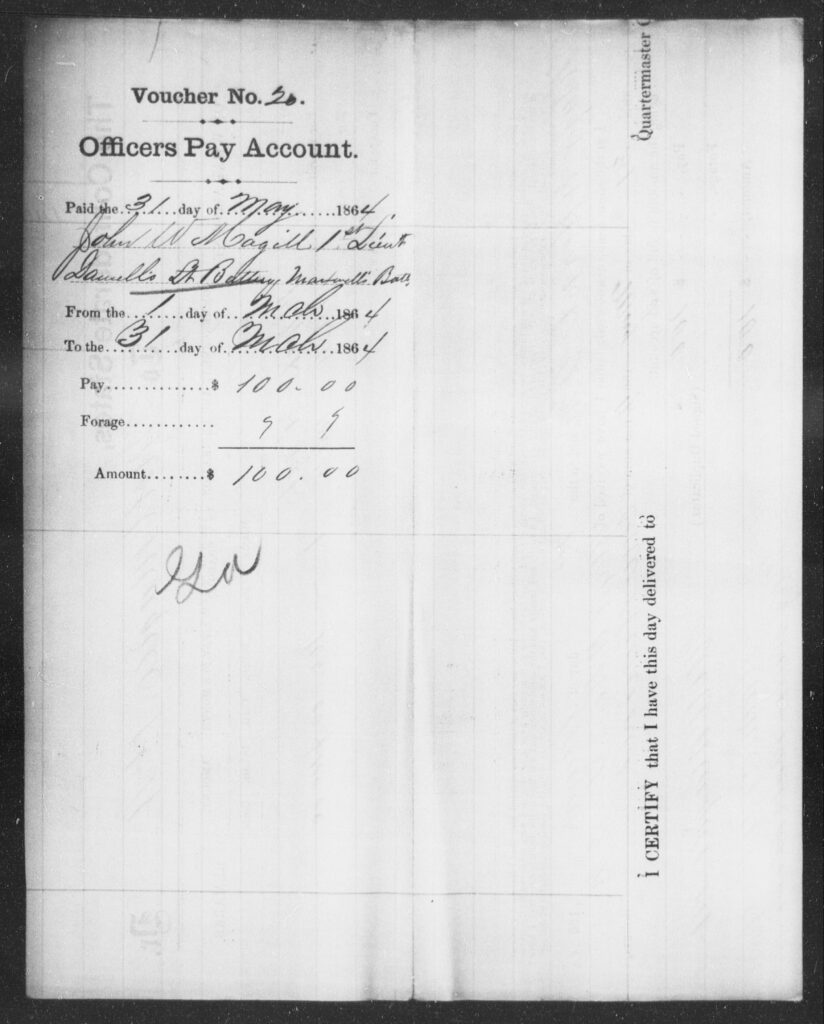
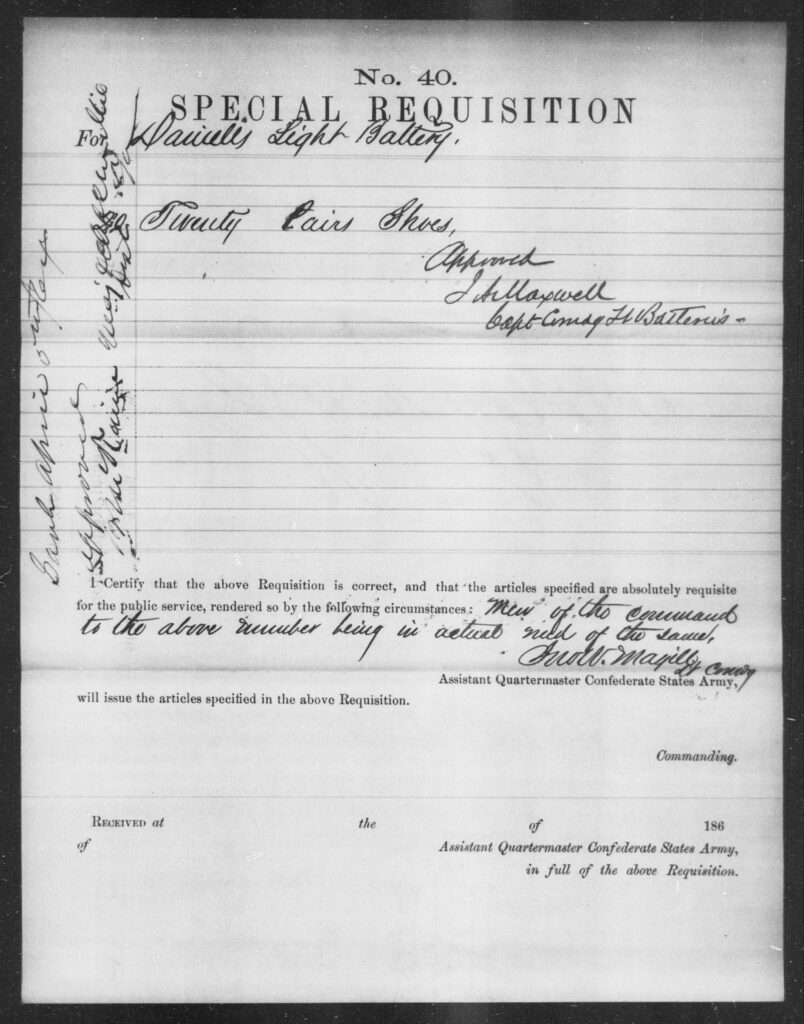
John W. Magill’s Confederate service can be found in the NARA Records of Carded Records Showing Military Service of Soldiers Who Fought in Confederate Organizations here: https://catalog.archives.gov/id/94320767?objectPage=29
After the Confederacy: Schemes, Paper, and Expedience
John W. Magill emerged from the Civil War at a moment when the social and economic order of the South was in open collapse. What followed was not a period of reflection or retreat, but a series of rapid recalibrations—each revealing how he attempted to reassert relevance, income, and authority in a post-Confederate world.
His first postwar move appears in late 1865, when he became briefly associated with the Georgia Land and Emigration Company. The proposal behind this venture was as revealing as it was implausible. Rather than contract with newly emancipated Black laborers—who were demanding wages, mobility, and autonomy—the company imagined that Southern agents could travel north, recruit white immigrants in New York and other Northern cities, and transport them south to replace Black labor entirely.
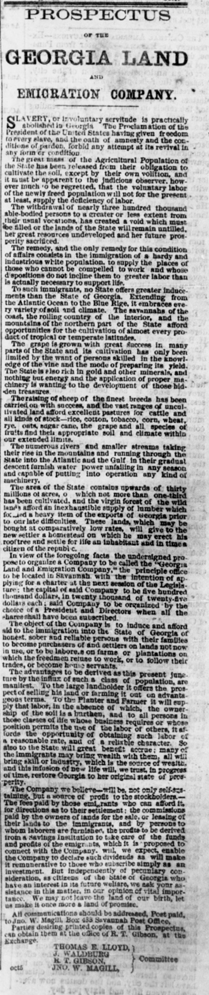
The plan rested on denial: denial of emancipation, denial of economic reality, and denial of Black agency. It was also deeply impractical. Within months, the proposal collapsed under its own weight. But Magill’s involvement is telling. Once again, he aligned himself with a scheme that promised control without negotiation and labor without accountability. When the idea failed, he moved on.
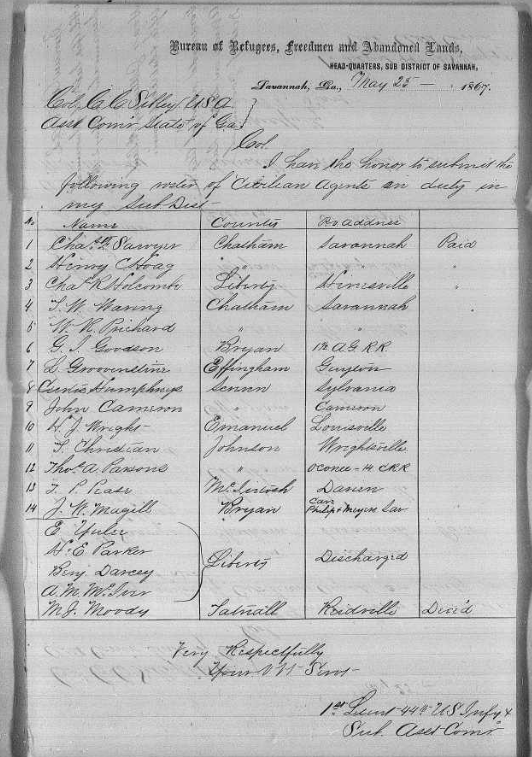
From there, Magill reappears—remarkably—within the orbit of the Freedmen’s Bureau as a registered agent of the Bureau, an institution tasked with managing the transition from slavery to freedom. Given his Confederate service, he should never have been accepted in any Bureau-related role. On paper, the Bureau was meant to protect the interests of newly emancipated people and to limit precisely the kind of manipulation Magill had practiced throughout his career.
Yet on Ossabaw Island, he surfaces again—this time positioned between freedpeople, land, and authority, operating through the firm Flye, Magill & Middleton, and as someone who has a stake in the land he purchased there after the war. His presence there speaks less to oversight than to systemic failure: the ease with which former Confederates, especially those fluent in paperwork, patronage, and persuasion, were able to insert themselves into Reconstruction institutions designed to restrain them.
It was a familiar pattern. When one structure collapsed, Magill did not withdraw. He repositioned.
What followed was more intimate—and more unsettling.
In November 1865, Magill traveled to Kentucky and married Frances C. Barker, a spinster whose circumstances suggest vulnerability rather than agency. Frances appears to have been orphaned, with an estate managed by a trustee. How Magill encountered her remains unclear, but the pattern is consistent: he attached himself to a woman whose legal and financial position could be leveraged.
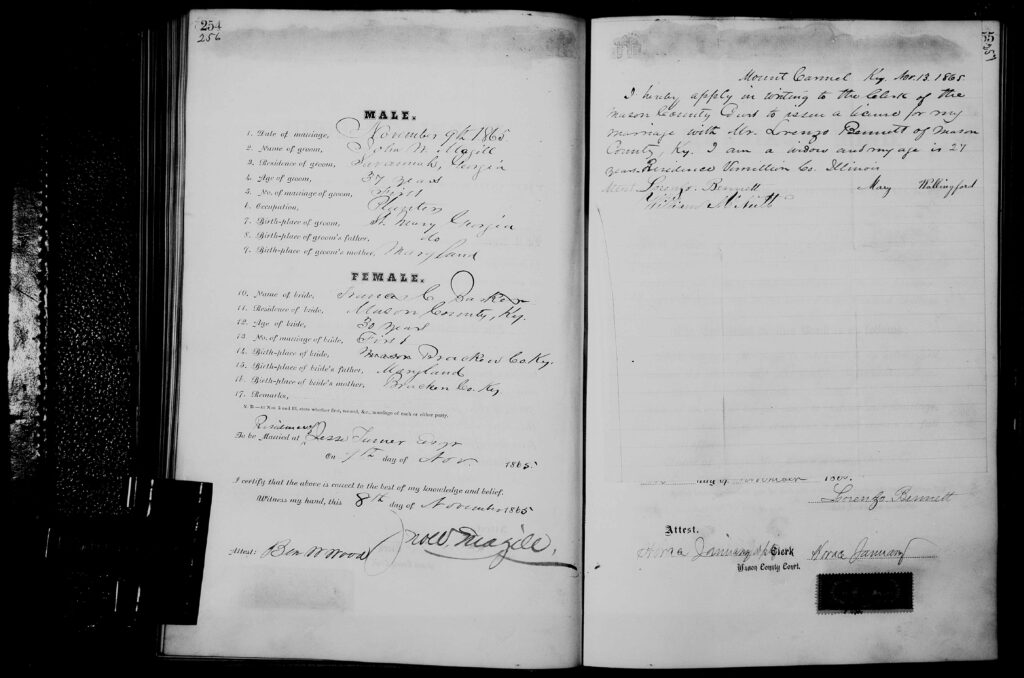
The marriage record contains a telling falsehood. Magill claimed he was born in St. Mary’s, Georgia, rather than in Placentia, Newfoundland. The substitution was strategic. St. Mary’s was a Southern port and the birthplace of his first cousins—close enough to sound plausible, and safely aligned with Confederate geography at a volatile moment. Newfoundland disappeared from the record.
Magill brought Frances Barker to Ossabaw Island, where she died in June 1866, less than a year after their marriage. There were no children.
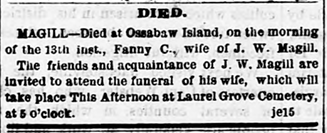
What remains is the outline of a man moving quickly through systems in flux—testing ideas, exploiting institutions, and entering relationships that offered opportunity rather than permanence. By the time Frances Barker died, Magill was once again unencumbered: legally, financially, and geographically.
In 1868, John W. Magill married again. The woman who entered that pattern was my second great-aunt, Eliza Huguenin Thomas.