Part III: Movement, Constraint, and Adaptation
Finding Eliza Huguenin Thomas Magill in the Record
In this third part of my second great-aunt Eliza Huguenin Thomas Magill’s life, I return to a question that has followed me through every document and every attempt to piece her together: how do I find her within the record that surrounds her?
Not simply where she lived, or what her husband did, but something closer to her own experience of it. She appears in the records with some consistency. I can place her in Philadelphia, at Limestone Springs, at Peru Plantation, and later in Chatham County. But those placements do not resolve into understanding. They mark her presence without revealing how she moved through those spaces or what they may have meant to her.
To get closer, I have had to work indirectly. I have faint firsthand accounts from my grandmother, who knew her in her lifetime. I have read Cousin Rosa’s letters carefully, knowing they carry a voice that emerged from Eliza’s world and remained within my own family. I have returned to the private memoir of my second great-grandfather, looking for even the briefest mention that might illuminate her presence. And I have followed the life of John W. Magill, not because I am drawn to his story, but because his movements often provide the only trace of where she might have been. Even with all of this, she remains just beyond reach, and I am left to reconstruct her through the structures that surrounded her.
Early Movements: Education, War, and Family
Eliza’s early life moved between McIntosh and Liberty Counties, places that defined the framework she inherited. In McIntosh, her family’s position was tied to land and to the labor of enslaved people whose lives are only partially visible in the records that remain. In Liberty County, education offered refinement and discipline, but not a departure from those same systems. It prepared young women to manage households and maintain order within expectations that were rarely questioned, even as the world around them shifted.
When she left for Philadelphia around 1860, I find myself lingering there, even though the record rests on a single diary reference from my 2nd great grandfather. Boarding away from home must have introduced a different rhythm of life, even if the expectations remained familiar. The experience of being elsewhere, of observing a different environment, had to have left some impression, even if it was one she could not fully carry forward when she returned at the start of the war.
By the time her brothers entered Confederate service, she was once again in motion. From Liberty County, she, her sister Mary Jane, and a young niece were sent to Limestone Springs, accompanied by their enslaved maids, to remain there during the final year of the war. Younger siblings were moved to Savannah to live with their grandmother, Eliza Vallard Huguenin, and their mother, Malvina Henrietta Huguenin Thomas, both widows at that point in time. This redistribution reflects a careful adjustment, one that allowed families with means to navigate instability while preserving structure.
Marriage and the Unsettled Ground of Reconstruction
After the war, Eliza married John W. Magill at her grandmother’s home in Savannah on January 1, 1868. John W. Magill is covered in the previous post, but he is the second man in the Thomas family whose origins were from Newfoundland. Her sister Mary Jane Thomas Gaden had married George Thistle Gaden in 1866, a fellow Newfoundlander who made his way South. I have spent enough time with John W. Magill’s record to understand how he presented himself: adaptable, forward-looking, and able to move into new roles as circumstances changed, even when they are at odds in purpose or execution. His earlier record suggests a man whose identity could shift with opportunity, a pattern that shapes how I read what follows.
By the 1870 federal census, Eliza and John were living at Peru Plantation within the Thomas family lands. Her younger sister Malvina was with them.

Most of the Thomas family was in Chatham County near Savannah or in Savannah with their grandmother Eliza Vallard Huguenin (she was in the 1870 Census on Liberty Street in Savannah just prior to her death). Her grandmother dies in late 1870 or early 1871. Eliza Vallard Huguenin’s holdings included the home on Liberty Street, lot 63 in the Brown Ward and substantial land (1,400 acres) southeast of Savannah near White Bluff and Isle of Hope, an area that would soon reappear in connection with the Magills as they moved between Chatham and McIntosh counties. That inheritance, shared among the Huguenin heirs, forms another layer of land and resource moving through the family at the very moment Eliza’s life was shifting into its next phase.
On January 1, 1869, one year after their marriage, John W. Magill wrote from Peru Plantation to the Freedmen’s Bureau proposing a school for the freed children of Harris Neck, the earliest reference I have found to such an effort there. The need he describes is clear, but the structure of his proposal appears designed to secure funding through his own involvement. Offering to supply the teacher—“a white lady of course”—and to board her at his place, he positioned himself within the operation of the school in a way that could carry financial benefit. A reply from the Bureau later that month acknowledges the need while outlining the conditions under which such a school might be supported, including shared financial responsibility and the expectation that freedpeople would contribute to the teacher’s compensation or guarantee her board. In that structure, access to education was contingent not only on federal support, but on the ability of newly freed families to provide resources they were only beginning to secure, placing the burden of establishing the school on those least positioned to support it.
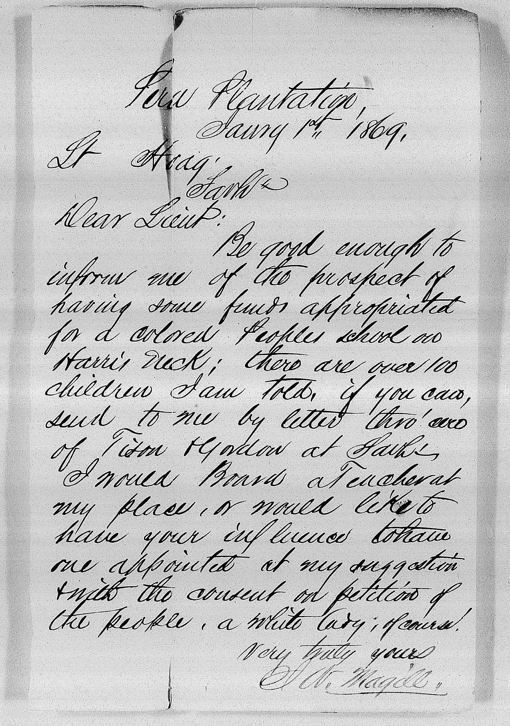
Freedmen’s Bureau Letters Received Records, Source: Family Search https://www.familysearch.org/ark:/61903/3:1:3QS7-L9GF-PLMB
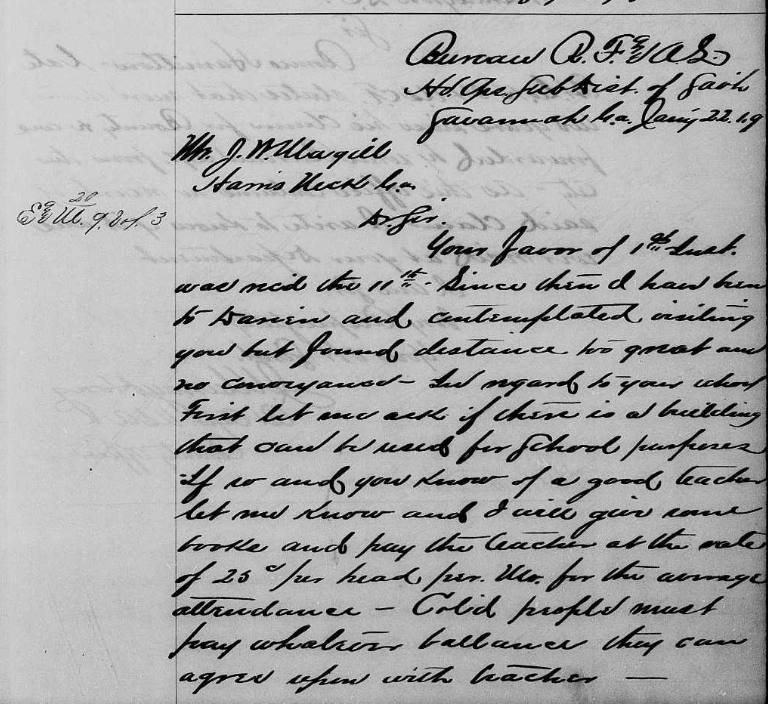
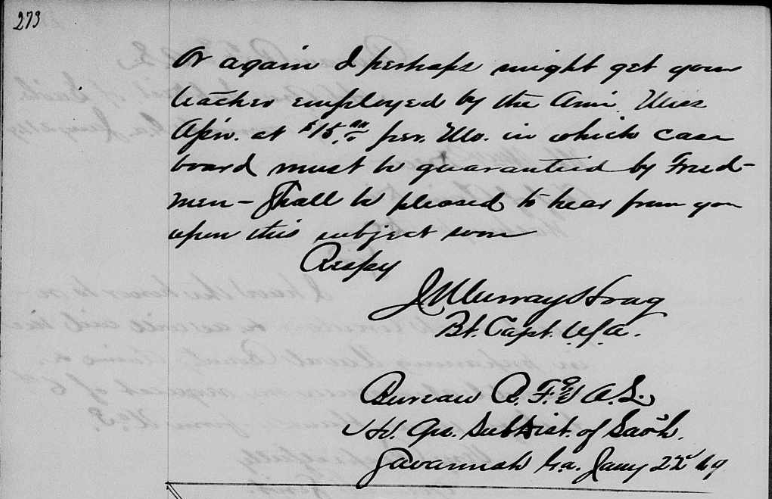
In just three years, tensions around land distributions erupted in the Thomas family, and that tension became visible. In the 1872 case of Malvina H. Thomas et al. vs. John W. Magill (C 388037, rcb: 1932, c: 388037. McIntosh County – Superior Court – Civil and Criminal Case Files, 198-01-001. Georgia Archives.), John W. Magill attempted to sell portions of the Jonathan Thomas estate before division. The court intervened, making clear that no sale could proceed without formal partition. Eliza appears in the case not only as his wife, but as someone with a direct legal interest in the land. Her presence there is one of the few moments where the record acknowledges her position explicitly.
Division, Loss, and the Move to Chatham County
In 1873, the Jonathan Thomas estate in McIntosh County was formally divided. Each heir received a corresponding lot across the Stark, Low, and Peru tracts, and Eliza’s share—Lot 6 in each—amounted to 523.5 acres. There were 8 family members with this same distribution. Together, this represented over 4,100 acres divided among the heirs. Knowing these three divisions has helped me track the land sales, which I hope to cover in another blog post.
1873 did not pass quietly. Eliza’s oldest brother, John Huguenin Thomas, died that same year, shortly after his marriage to Eliza “Lila” Amanda Curtis (my 2nd great grandmother Alice Gertrude Walthour Thomas’s niece). His death is only briefly noted in surviving records, especially when compared to later family losses. Its timing alongside the division of land suggests a moment in which both property and family structure were shifting at once.
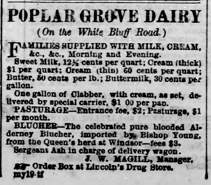
Within that same year, the Magills appear in Chatham County. John W. Magill filed a homestead exemption tied to a dairy operation on White Bluff Road, listing household items, equipment, and 30 head of cattle. Newspaper notices align with this record, identifying him as a dairy manager. It suggests a move toward a more practical enterprise, possibly connected to land within the Huguenin holdings in that area.
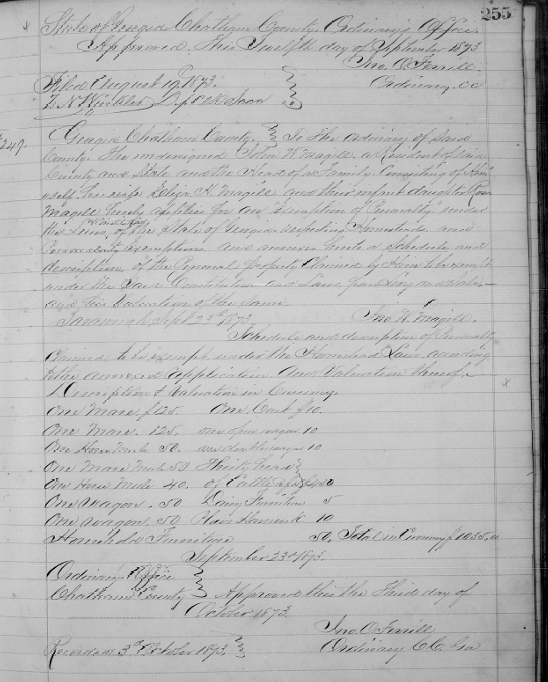
What draws me back to this moment is Rosa. This is the first time she appears in the records with her name, in her birth year. She appears in the homestead record as an infant, named and accounted for. It is a small detail, but it brings a sense of immediacy that the rest of the record often lacks. Through her, the distance between document and life narrows, if only slightly.
The Magnolia House
By the mid-1870s, Darien had reestablished itself as a working coastal town, rebuilt after its destruction during the Civil War and sustained by timber, rice, and river trade. The Magnolia House stood along the waterfront on Broad Street, positioned where arrivals and commerce converged. It was more than lodging. It functioned as part of the town’s infrastructure, hosting meetings, travelers, and the steady movement of people tied to the regional economy. With its own wharf for steamship arrivals, this hotel occupied one of the most visible spaces in Darien.
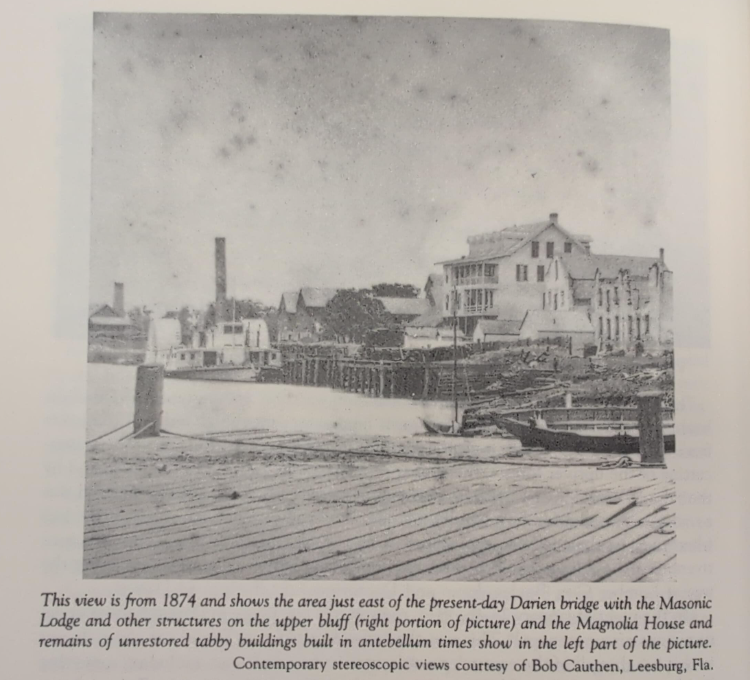
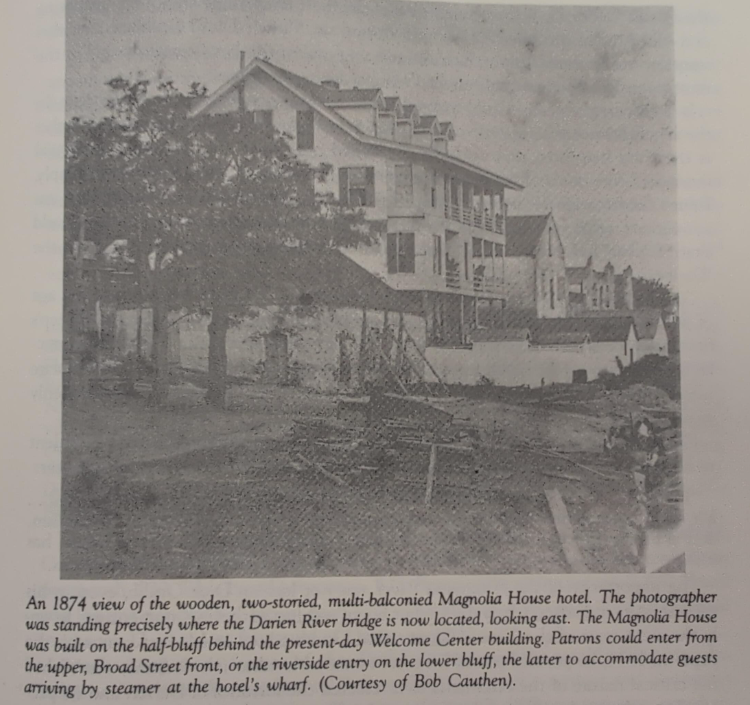
By 1875, John W. Magill appears in the newspapers as proprietor of the Magnolia House, referred to as “Captain Jack.” The role reflects operation rather than ownership, placing him within an existing structure rather than one he created. Under his management, the hotel became a central hub of activity. Newspaper accounts describe meetings, arrivals, and elaborate meals, suggesting a place that was both socially and economically significant.
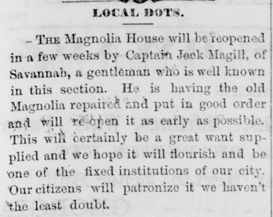
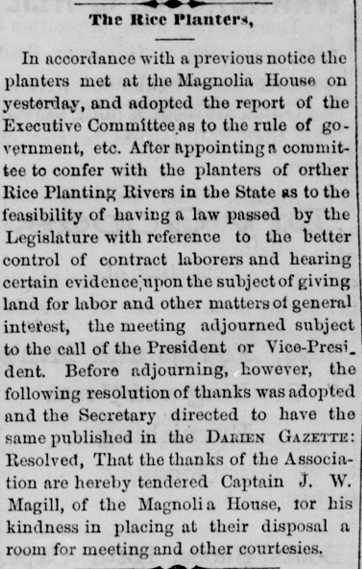
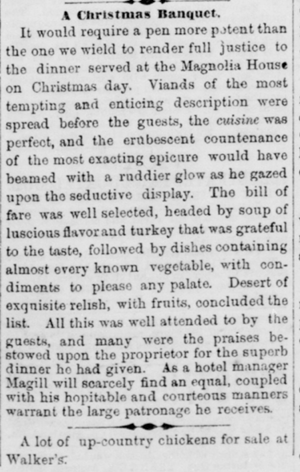
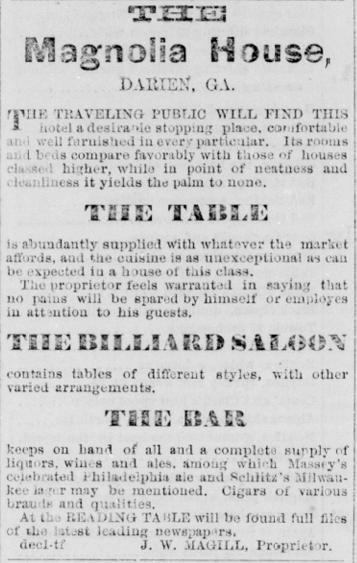
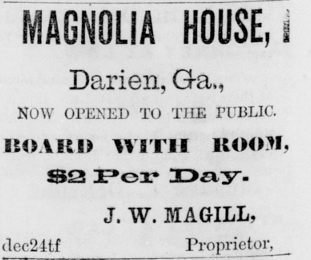
A hotel like the Magnolia House depended on constant management. Guests arriving and departing, meals prepared, rooms maintained, accounts tracked, and labor directed. It required a steady presence, someone who understood not just how to maintain order, but how to create the appearance of ease within it. Those are not skills that appear suddenly. They are learned over time, often in places that are not recorded as training grounds but functioned as such.
When I think back to Eliza’s time in Philadelphia, or to Limestone Springs, I begin to see those experiences differently. Boarding schools were not only places of instruction. They were environments where girls and young women were expected to observe, to participate, and to internalize how a structured household—or something larger than a household—operated. The lines between domestic life and institutional management were not as separate as they might seem now.
By the time the Magills moved into the Magnolia House, those lessons would not have been abstract. They would have been part of a way of moving through the world, even if the record does not name them as such.The records that mention Magnolia House tend to center on John W. Magill, just as earlier records do. His name appears in advertisements, in notices, in the kinds of references that mark ownership or management in a public sense. It is consistent with everything I have seen so far, where his role is visible and hers is implied. But a place like Magnolia House does not run on implication alone.
I find myself returning, again, to what I cannot see clearly.
Who greeted the guests? Who oversaw the rhythms of the day, the meals, the movement through the house? Who managed the labor that made the entire operation possible? These questions do not appear in the record, but they are embedded in the functioning of the place itself, and it is difficult to imagine that Eliza was absent from them.
At the same time, I try to be careful not to fill in too much simply because the space invites it. The absence of her name in the public record is not the same as proof of her role, even when that role feels likely. What I can say is that the Magnolia House represents a continuation of the pattern I have been tracing— the ability to maintain structure within shifting circumstances.
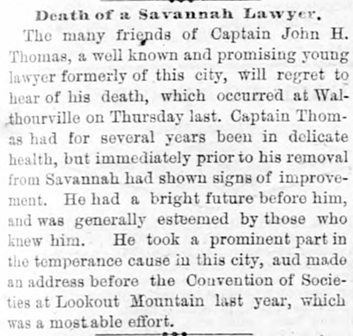
I get a break from her absence, though, thanks to a local researcher in McIntosh County, who showed me a remarkable document in the county courthouse on one of my visits to Harris Neck. In December of 1876, the entire contents of the Magnolia House were deeded from John W. Magill to his wife Eliza for the nominal sum of ten dollars. The inventory is extensive, capturing the material reality and largess of the hotel in exquisite detail. It’s a sight to behold. On the surface, the deed was based on the “love and affection” Magill had toward his wife in deeding the contents of the hotel to her. However, the deed hints that there are mounting debts the Magills have taken on.
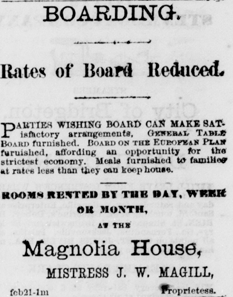
A February 1878 notice in the Darien Timber Gazette signaled a change. Eliza is named as “Mistress J. W. Magill” in a new ad for the Magnolia House with a short note in another section that she is now the “Proprietress.” She had attained a rare feat. She was running the show. In 1878, Eliza would be 36 years old with a child 5 years of age. When I saw she was the proprietress, I silently cheered her on. This increased visibility, however, coincided with mounting lawsuits against her husband, suggesting financial strain. No matter how hard Eliza worked to resolve the situation, her husband’s ambitions and erratic behavior likely pulled them into debts they could not avoid.
By April of 1879, the Magnolia House was closing after three plus years of operation under the Magills. It would be closed temporarily before a new Proprietor would take on the venture. I have found no evidence of sales of the hotel’s interior between Eliza and a new owner, and I have no idea how the Magills left with any profits. I do know that part of the McIntosh Thomas land (both Stark and Low, but not Peru) had to be sold to solve a court case brought against John W. Magill, and that John W. Magill had to sell land he owned on “Moss Island” to pay overdue taxes. Within months, John W. Magill had relocated to Titusville, Florida to run another hotel. Eliza and Rosa returned separately to Savannah, their movements no longer aligned.
That same year, another loss enters the record. Mattie King Thomas, Eliza’s youngest sister, died in Darien after an illness. Her loss is described in detail in Edward J. Thomas’s memoir, in contrast to the brief acknowledgment of their brother’s earlier passing. Her presence in Darien connects the place not only to business, but to family loss.
Atlanta: The Breaking Point
After Darien, the pattern does not resolve. It fragments.
By 1880, the federal census places the Magills in Gwinnett County, in the Sugar Hill area, marking another move away from the coastal world that had defined the previous years. Even there, the record resists stability. Across census entries, John W. Magill’s reported age shifts in ways that do not align with his known chronology, suggesting a fluidity in how he represented himself that complicates any fixed reading of his life. At the same time, notices suggest that he was again attempting to establish himself in the hotel trade, this time near Atlanta. The choice of Atlanta may be one that unites both families with other family members in the area. Eliza’s sisterinlaw “Lila” Curtis Thomas (a widow since 1873) lived with her mother running boarding houses in Atlanta, and John W. Magill had family relatives who lived in Roswell, Georgia.

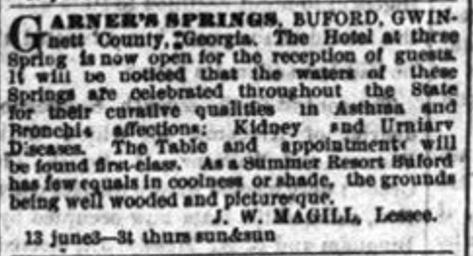
In November of 1881, that pattern breaks.
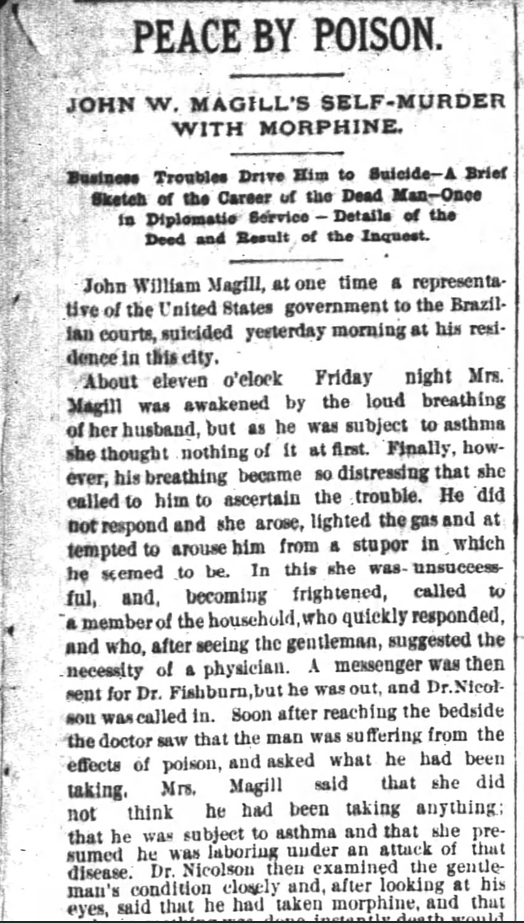
John W. Magill died in Atlanta by suicide with an overdose of morphine. The newspapers record the event in detail, but the meaning remains difficult to assign. Even his burial seems shrouded in mystery. His membership cards in the Odd Fellows and Masons (from his days in Chicago) indicate they will take his body and bury it. I believe he is buried in Atlanta’s Oakland Cemetery, as there is a corresponding entry for him. No grave markers exist for him, however. He disappears as strangely as he appeared in my research when I was just wondering one thing: Was he from Newfoundland? How far I’ve traveled with this man in my research.
Within days, Eliza appears in the same papers, advertising for boarders at an address on West Hunter Street. The notice is practical, direct, and without reflection. What had once been structured through her husband’s ventures now continues through her own.
After Magill: Movement Without Him
What follows after 1881 shifts the record, and the way Eliza appears within it.
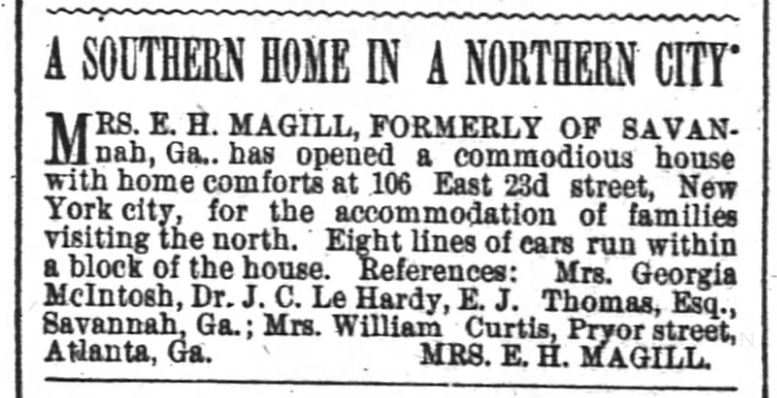
By 1884, she surfaces in New York as Mrs. E. H. Magill, attached to a boarding establishment. Eliza would venture to the city of her sister Mary Jane Thomas Gaden (still married at the time), and it would signal a dramatic shift in her world, one of independence and bravery. It was through this notice that I first understood her as a widow, long before confirming the details of Magill’s death. Even then, the identification required reconstruction, with conflicting references to his consular service and an obituary that did not immediately resolve to him.
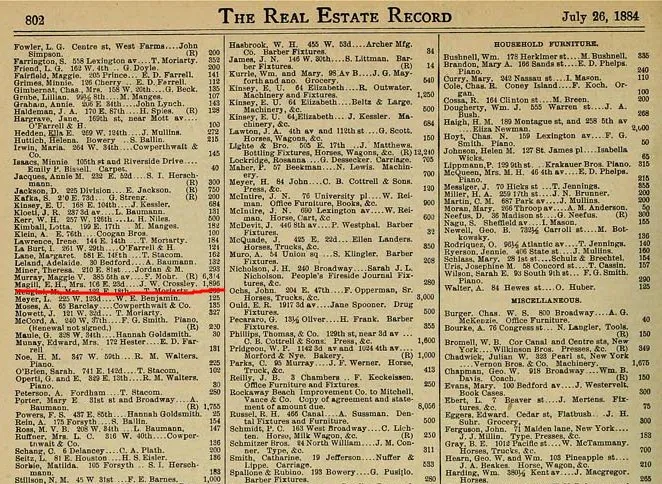
In July of 1884, a small entry appeared in the Real Estate Record, a weekly publication tracking property transactions across New York City. Within a column of chattel mortgages dated July 26, 1884, it reads: “Magill, E. H., Mrs. 106 E. 23d…J. W. Crossley, 1,895.” In the language of the record, Eliza is the mortgagor — the borrower — and J. W. Crossley the lender, with $1,895 secured against personal property rather than real estate. It is brief and easy to overlook, but for someone who has spent years trying to find Eliza within the record, it is anything but small.
What personal property Eliza brought to that arrangement remains an open question. Eight years earlier, the entire contents of the Magnolia House in Darien had been deeded to her by her husband — furniture, linens, and the material substance of a working hotel — for the nominal sum of ten dollars. Where those contents went after the hotel closed in 1879 is not clear from the record. But it is difficult not to wonder whether some portion of what furnished 106 East 23rd Street had once furnished a waterfront hotel on the Georgia coast, carried northward by a woman who had learned, more than once, how to make something from what she had.
Paired with the newspaper advertisement already placing her at 106 East 23rd Street throughout 1884, this entry gives her presence in New York a texture the advertisements alone could not provide. Three years after her husband’s death in Atlanta, she had made her way to one of the most expensive cities in the country and established herself within it, formally enough to appear in a publication that was not in the habit of noticing people who were merely passing through.
From that point forward, Eliza becomes both more visible and more difficult to follow. The record places her in Davenport, Iowa, during the years when her daughter Rosa attended St. Katharine’s School (1889-1893). Legal documents in McIntosh county and Chatham County signed from Scott County, Iowa confirm her presence there, managing family land interests in Georgia while living elsewhere.
Even then, the connection to land in Georgia did not entirely disappear. After the complicated partition of her grandmother Eliza Huguenin’s estate among the Huguenin heirs, Eliza Huguenin Magill held a defined portion of that inheritance. By 1900, a Savannah newspaper notice records that 150 acres associated with Eliza’s share were subject to possible sale for unpaid taxes, a reminder that these holdings continued to carry obligations even at a distance. Subsequent records indicate that she continued to sell portions of her Peru lands in the years that followed, suggesting that this inheritance functioned not only as property, but as a resource she drew upon to supplement her income as her life moved further from Georgia.
Rosa’s education becomes a point of stability. Her later work as a teacher in Waverly, Iowa and her recognition within that community suggest a continuation that moves beyond the constraints that shaped Eliza’s earlier life. But even while Eliza was in Iowa, I have found no evidence of her residence. Was she operating a boarding establishment? Was she seen in social circles? What was her life like? I suspect she may have continued working in boarding establishments, which may explain the difficulty I have had in placing her in a 1900 or 1910 census record. It’s very possible that she lived off and on with her sister Mary Jane Thomas Gaden in New York because she also seems to live under the radar of public notices much of this time. If Eliza worked within a school boarding environment, that could explain why she is not enumerated, but my searches will continue as more information releases online every day.
What is clear is that Eliza does not remain in one place. By the mid-1890s, she returns to New York, appearing only in brief references—visits to Lake George at the Rising House with her then-divorced sister Mary Jane Thomas Gaden, possible work in a girls’ school as captured by an unconfirmed 1905 census (I can’t truly say this record is my 2nd great aunt Eliza), and continued involvement in household management I presume. These traces are lighter, but they suggest continuity. Without the land transactions, I have not been able to locate where Eliza actually lived (no defined address, no real domicile) for almost 20 years.

In 1890, her mother, my 3rd great grandmother Malvina Henrietta Huguenin Thomas passed away in Savannah. Her mother had lived a long life, just as her grandmother did. In the obituary for Malvina, Eliza is listed as being from New York City, along with her sister Mary Jane.
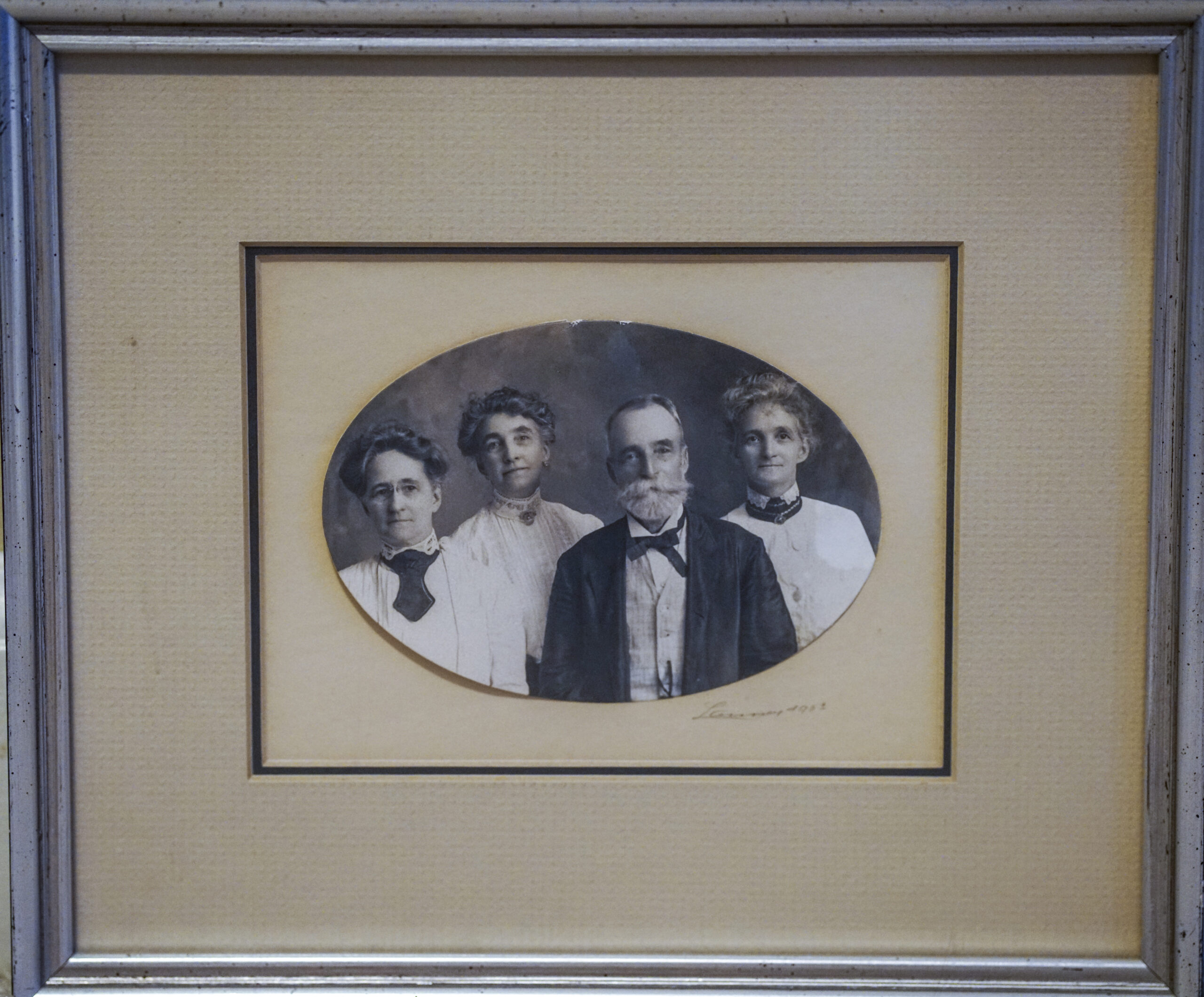
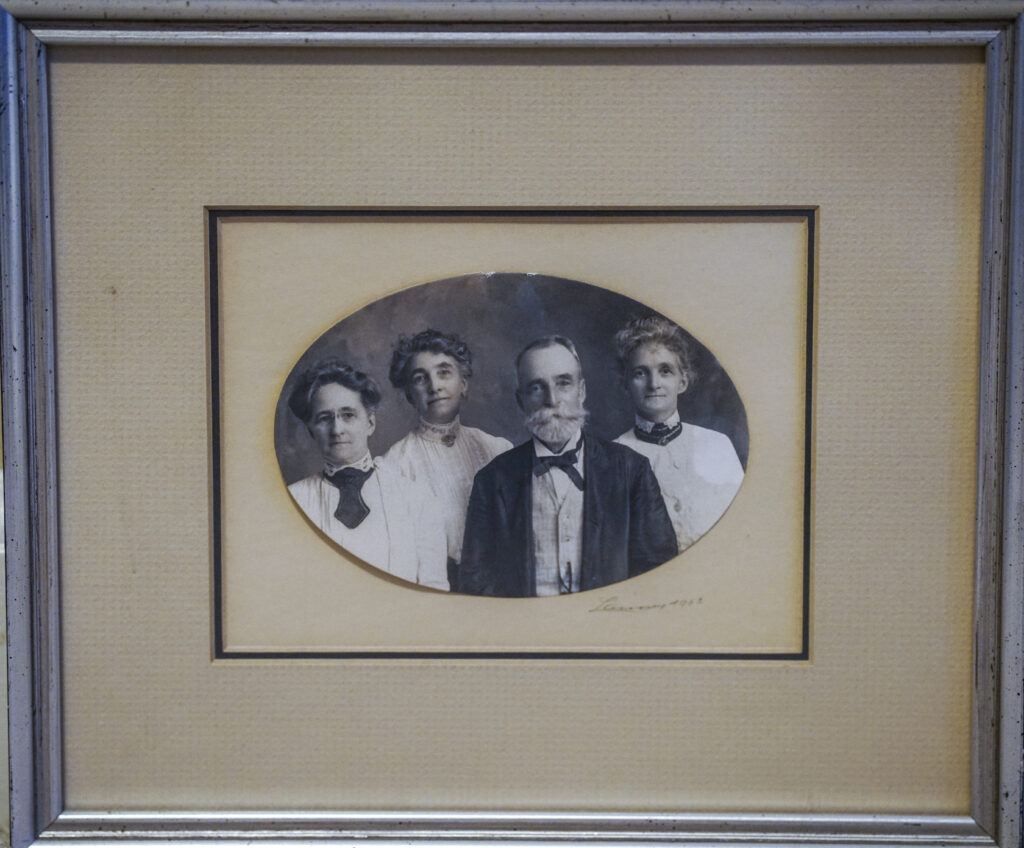
Right around the turn of the century (in about 1901), I have the only existing photograph of Eliza with her sisters Malvina and Mary Jane, with their brother Edward Jonathan Thomas. This confirms she was moving between Savannah and New York City, which I can find on some ship registers.
After a long absence in the records, Eliza appears in the 1920 federal census for the first time since 1880 within her daughter’s household on West 136th Street in Manhattan. Rosa, now married to Edmund D. Weston, had established a home that becomes the final setting in which Eliza can be clearly placed. The direction of movement has shifted. Where she once moved within structures shaped by her husband’s work and her inherited obligations, she now lives within one defined by her daughter’s life.

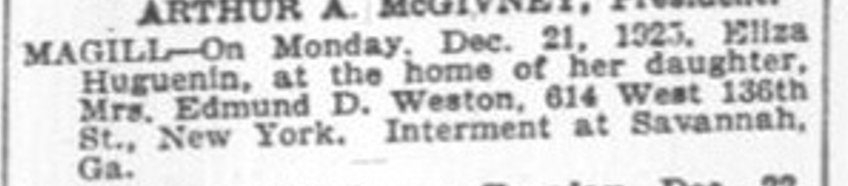
In December of 1925, Eliza Huguenin Thomas Magill died at her daughter’s home in New York. The notice is brief, recording her death and her return to Savannah for burial.
What remains is not a complete portrait, but a pattern. Movement between places, roles shaped by circumstance, and a life that can be followed, though never fully captured.
And in the end, I can trace her movements across these places and records, but the question remains much the same as when I began: how do I find her within them, and what does it mean that she is both present and still, in some essential way, just beyond reach?